
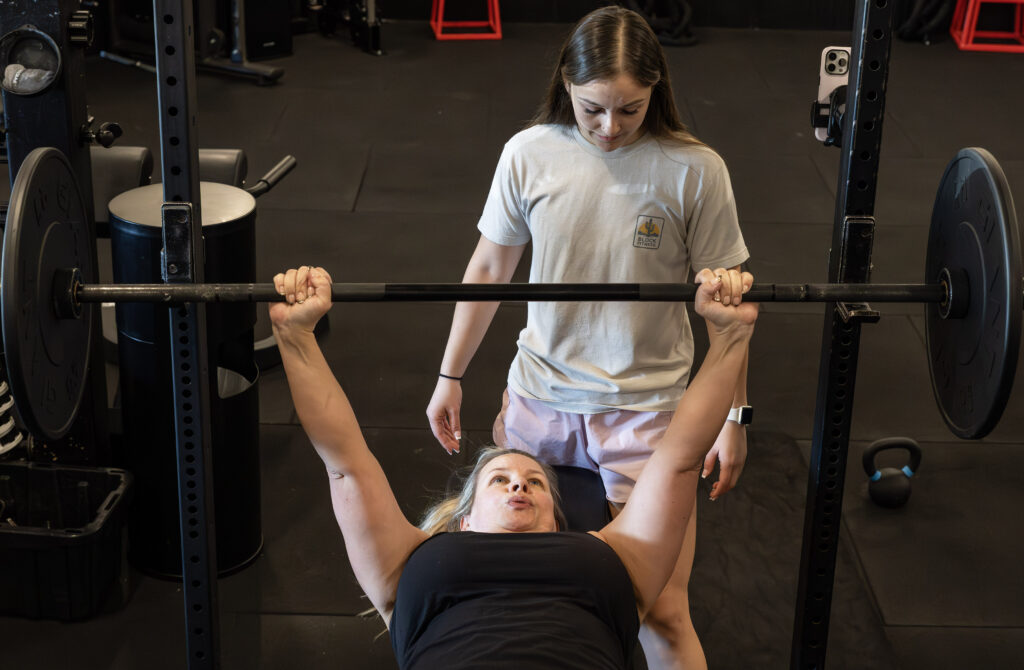
Strength training when injured over 40 isn’t a contradiction — it’s often the most important thing you can do. At Block Fitness in Tucson, we hear the same three phrases constantly: “I’m always injured.” “Everything hurts.” “My schedule sucks.” And here’s the truth: nearly everyone we coach is dealing with at least one of these. Bodies get cranky. Life gets complicated. Sleep gets disrupted. Stress accumulates in ways that show up as real physical pain. This doesn’t disqualify you from training. It changes how you train.
This guide is a real-talk look at how to navigate training when your body isn’t cooperating — and why adults in Tucson, Oro Valley, and the Catalina Foothills who figure this out are the ones who make consistent progress for years.
The Most Common Barriers Adults Over 40 Face in Training
Before we talk about solutions, let’s name the problems honestly. Because the “I’m always injured” crowd isn’t making excuses. They’re often dealing with very real, very frustrating physical limitations.
Chronic Joint Pain and Old Injuries
Most adults over 40 have at least one body part that never fully healed — a shoulder from a car accident, a knee from a sports injury, a back that “goes out” periodically. These aren’t imaginary. They require real modifications, not cheerful dismissal.
Unpredictable Recovery
After 40, your body takes longer to recover from hard training, poor sleep, and high stress. A workout that left you functional at 32 might leave you wrecked for three days at 48. This isn’t weakness — it’s biology. The National Institute on Aging acknowledges that recovery capacity changes with age and recommends adjusting training accordingly.
Life Demands That Compete with Training
Work pressure, family obligations, caregiving, insufficient sleep, travel — these don’t just reduce time available for training. They physically degrade your body’s ability to respond to and recover from exercise. High chronic stress elevates cortisol, which interferes with muscle protein synthesis and increases injury risk. This is a real physiological barrier, not a mindset problem.
How to Train Smarter When You’re Always Dealing with Something
Strength training when injured over 40 requires a different philosophical approach than training when you’re 25 and healthy. The goal isn’t to train through pain. The goal is to train around limitations while maintaining progress in the areas you can.
1. Treat Pain as Information, Not a Stop Sign
Sharp, acute pain during a movement is a stop sign. Dull, chronic ache in a joint is information — it tells you the movement needs modification, not elimination. Learning to distinguish between “this doesn’t feel right” and “this hurts” is one of the most valuable skills in training over 40. Work with a coach who can help you make this distinction and modify accordingly.
2. Train What You Can
Bad shoulder? Your legs are fine. Bad knee? You can still press, pull, and build upper body strength. Something always hurts? Something always works. The adults at Block Fitness who make the best progress through injuries are the ones who find what they can do rather than focusing on what they can’t. This mindset is the difference between maintaining fitness through a challenging period and losing it entirely.
3. Reduce Volume Before Reducing Frequency
When life is hard and your body is under stress, the instinct is to skip the gym entirely. A better approach: reduce the volume (sets, reps, intensity) of your sessions rather than eliminating them. A 20-minute session at 60% intensity keeps the habit alive, maintains your body’s training adaptation, and gives you a win on a hard day. Explore our strength training over 40 resources for examples of minimal effective dose training.
4. Work With a Coach Who Understands Adult Bodies
Generic fitness programming is designed for healthy, recovered adults with abundant training time. If you’re over 40, dealing with chronic issues, and navigating a demanding life — you need programming designed for your reality. Our semi-private training program at Block Fitness is built around exactly this: individualized attention, movement modification, and programming that accounts for what’s actually happening in your life.
5. Address Recovery as Seriously as Training
If you’re always injured, recovery quality is the first thing to audit. Consistent 7–9 hour sleep, adequate protein (0.7–1.0 g/lb bodyweight), manageable stress load, and deliberate deload periods are often more valuable interventions than any specific exercise modification. The CDC emphasizes that sleep quality directly impacts injury risk and recovery capacity — something most adults dramatically underestimate.
The Schedule Problem: When Life Keeps Getting in the Way
Even with the best intentions, schedules collapse. A week turns into two weeks. Two weeks turns into “I fell off.” This cycle is incredibly common among adults over 40, and it’s not a motivation problem. It’s a planning problem.
The solution isn’t more discipline. It’s a more realistic plan. Specifically:
-
Define your minimum viable training week. What’s the absolute minimum you can commit to — even in your worst weeks? Two 30-minute sessions? That’s enough to maintain significant fitness and prevent detraining.
-
Treat scheduled training like medical appointments. You don’t cancel a doctor’s appointment because you’re tired. Apply the same non-negotiable status to your two minimum sessions.
-
Stop trying to make up for missed time. Coming back after a break and trying to cram in extra sessions to compensate leads directly to the injuries you’re trying to avoid. Ease back in at reduced volume.
What Strength Training Does for Injuries and Chronic Pain
Here’s the counterintuitive truth: for most chronic joint pain and overuse injuries, well-executed strength training is often more effective than rest. The connective tissue around joints — tendons, ligaments, cartilage — responds positively to graduated loading. Avoiding movement leads to deconditioning, which makes tissue more vulnerable to future injury, not less.
Research increasingly supports the role of resistance training in managing conditions like tendinopathy, osteoarthritis, and chronic low back pain. The CDC’s physical activity guidelines recommend strength training specifically for adults dealing with arthritis and chronic pain conditions as a first-line management strategy — not as something to avoid.
Frequently Asked Questions: Strength Training When Injured Over 40
Can I strength train with a bad back?
In most cases, yes — with appropriate modifications. The specific exercises that are safe depend on the nature and cause of your back issue, but many people with chronic low back pain actually improve significantly with proper strength training, particularly core and hip strengthening. Always work with a knowledgeable coach and consult your healthcare provider for severe or acute injuries.
How do I know if I should rest or push through?
Acute injuries (sudden, sharp pain during a specific incident) typically require rest and medical evaluation. Chronic soreness and stiffness usually respond better to movement than to complete rest. The key question is: does movement make it worse, or does it improve after warming up? If it improves with movement, gentle training is usually appropriate.
What if I miss two or three weeks of training?
Meaningful detraining (measurable loss of strength and conditioning) typically takes 3–4 weeks of complete inactivity to begin. Missing 1–2 weeks has minimal physiological impact. Come back at reduced intensity and volume — your body will regain previous fitness levels faster than it took to build them.
Is pain-free training realistic for adults over 40?
Completely pain-free training is often not realistic for adults over 40 with pre-existing conditions. But training at a tolerable pain level (typically 3–4/10 or less on a pain scale) while avoiding movements that produce sharp or worsening pain is both safe and effective. The goal is managing, not eliminating.
Can strength training actually fix my injuries?
For many overuse injuries and chronic conditions, yes — progressively loading the affected tissue through appropriate strength training promotes healing and resilience. Many tendon and joint issues that don’t respond to rest alone improve significantly with graduated resistance training. This is well-documented in sports medicine literature and increasingly recognized in clinical guidelines.
The Bottom Line
Strength training when injured over 40 isn’t about ignoring pain or pushing recklessly through limitations. It’s about building an approach to fitness that accounts for your real life — the injuries, the schedule, the stress, and the demands that don’t wait for perfect conditions. The adults who build lasting fitness in their 40s, 50s, and beyond aren’t the ones who wait until everything is aligned. They’re the ones who learned to train in spite of imperfect conditions.
At Block Fitness in Tucson — serving Oro Valley and the Catalina Foothills — this is exactly what we do every day. We meet you where you are and build from there.
Move Better. Feel Better. Live Stronger.