
Every one of you did half a squat to sit down today. At some point you’ll do the other half to stand back up.
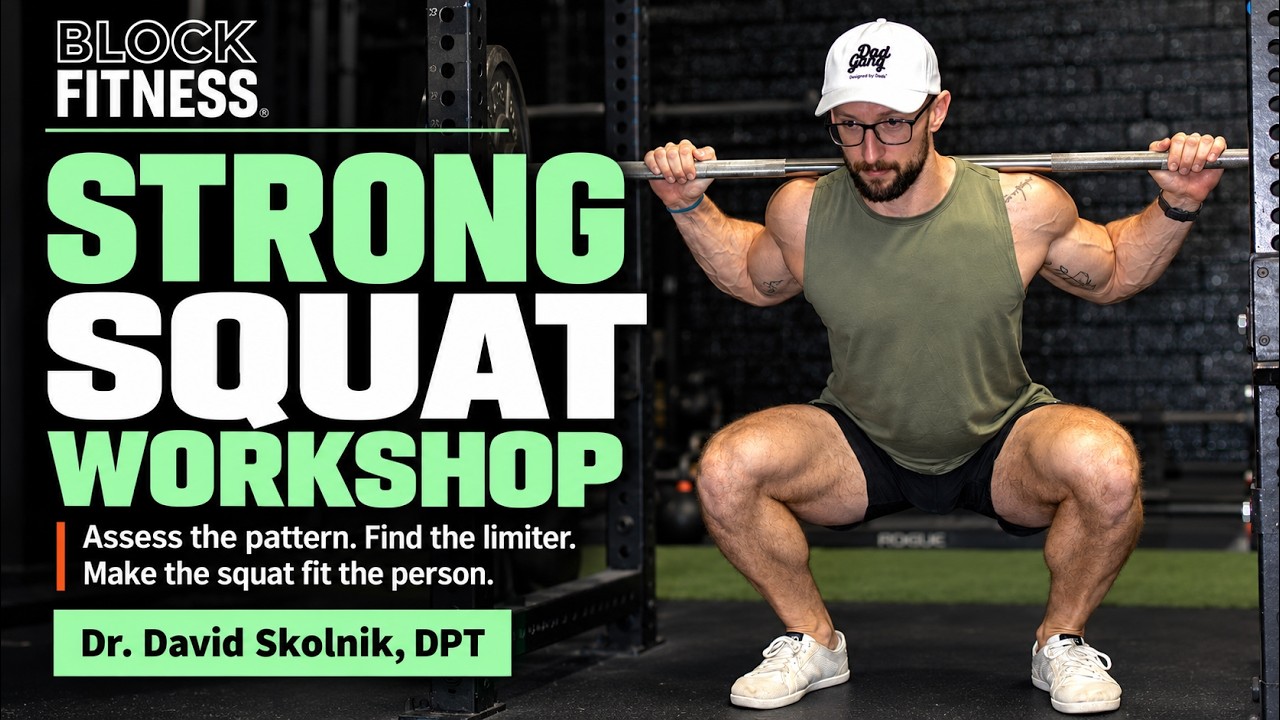
That’s how Dr. David Skolnik, DPT opened his Strong Squat Workshop at Block Fitness. David is a physical therapist and personal trainer from the Gilbert and Mesa area with more than 11 years in the field. He came back after his deadlift workshop to teach our coaches and members how to assess the squat, find what’s limiting it and build squat form that fits the person instead of a textbook.
The big idea: good squat form looks different on different bodies. Forcing everyone into the same stance usually makes their squat worse.
Why the squat matters so much
The squat isn’t just a gym exercise. It’s how you get out of a chair, off the toilet, out of a car and up off the floor. David pointed out that one of the most common reasons people lose their independence as they age is simply being unable to get up from a low seat on their own.
You may have heard that squatting is bad for your knees or hips. The evidence points the other way. Motion is lotion for your joints.
David cited the Beijing Osteoarthritis Study, which took hip X-rays of more than 1,500 adults age 60 and older in Beijing and compared them with older adults in the US. Hip arthritis was 80 to 90% less common in the Chinese group. The researchers called for more work on the genetic and environmental reasons. David’s take is that daily life is a big part of it. Much of Eastern culture squats all the way down to cook, eat and use the bathroom. Western culture sits in chairs that stop you above parallel.
And it’s never too late to start. David has worked with clients well into their 90s and 100s, and even very frail adults in assisted living make big strength gains from simple leg work.
The 5 checkpoints of good squat form
David doesn’t use the word perfect. He looks for a squat that is good enough for what you’re asking it to do. Here’s his checklist:
- Depth. Hips roughly level with the knees, which is what parallel means. Lower is great if you can own it.
- Full foot contact. Heel, big toe and little toe stay on the floor the whole time.
- Matching angles. From the side, your shin and your torso are roughly parallel to each other.
- A neutral spine. Your spine always moves a little, but no big arch and no tucking your tail at the bottom.
- No shifting or twisting. You go straight down and straight up.
Notice what’s missing: a rule about where your feet go. David uses foot position to hit these five checkpoints. Feet at shoulder width with toes straight ahead is not one of them.
His goal as a competitive powerlifter was for his first warm up set to look exactly like his heaviest squat. That’s the standard for everyone. Good squat form is a squat that looks the same every rep.
The live demo: same stance, worse squats
David brought three people up to squat in their own stance. All three looked solid, and all three looked different. Then he made them squat with feet under the hips and toes forward.
Every one of them got worse. Depth dropped. Torsos leaned further forward. One lost balance completely. The stance they chose on their own was the one that let them pass the checklist.
Find what’s limiting your squat
Watching a squat only tells you what’s off. It doesn’t tell you why. David focuses on two joints, the ankle and the hip.
The ankle test. Face a wall or rack. Make a fist and place it between your big toe and the wall, then try to touch your knee to the wall without your heel lifting or your arch collapsing. If you can’t, your ankles are likely stiff. David puts normal ankle range at roughly 25 to 35 degrees.
Stiff ankles usually show up as a big forward lean, and the low back pays for it. In David’s words, your ankles are the ones breaking into the house, but your back is the one that feels robbed. He once helped a client with severe sciatica by spending two weeks mostly on calf and ankle mobility and changing how she squatted. Most of her pain went away.
The hip test. Sit on a high box with your feet dangling and rotate your shin in and out. Inward rotation of the foot is external rotation of the hip, and the reverse is internal rotation. Combined, the two should add up to roughly 90 degrees, often around 60 out and 30 in. Most people have more on one side than the other, and that’s normal. Hip sockets differ in depth and angle, and a lifetime of habits and sports adds to it.
How to fix your squat form today
Stiff ankles? Elevate your heels with squat shoes, a slant board or small plates. This gives you extra ankle range right away. Your torso stays taller and you’ll likely squat deeper.
Stiff hips? Go a little wider and turn your toes out. That centers the hip in its socket so it can move more freely.
Both? Do both. Look at the best squatters in the world. Powerlifters and Olympic weightlifters almost all squat in raised heel shoes with a wide stance and toes out.
One side tighter than the other? It’s okay for your feet to be asymmetrical. The side with less internal rotation usually needs to turn out more. Whatever lets you go straight down and up without shifting is the right stance.
David’s squat warm up
- Foam roll each calf and each glute for about a minute.
- Stretch your calves against a wall or rack for 10 deep breaths per side.
- Band mobilize your hips in half kneeling, with a band high on the front leg, for 10 to 15 reps each side.
New range needs new control. Once you’ve loosened up, David’s four bracing cues lock it in:
- Spread the floor. Push your feet out like you’re tearing a paper towel at the seam.
- Bend the bar. Pull the bar around your shoulders to tighten your upper body.
- Sniff and brace. Short breath in through the nose, ribs down toward the pelvis, like you’re ready for a poke in the stomach.
- Squat. Hold all of it the whole way down and back up.
Think piston, not slinky.
What this means for you
If your coach has you squatting with your heels on plates, your stance wider than the person next to you or one foot turned out more than the other, now you know why. Those adjustments are your squat form, built for your body.
If you missed David’s first visit, catch the deadlift workshop recording next. And if your knees complain when you squat, read why your knees usually aren’t the problem.
Not sure your stance is right for you? Ask your coach to run the ankle and hip screens at your next session.
– Joseph