
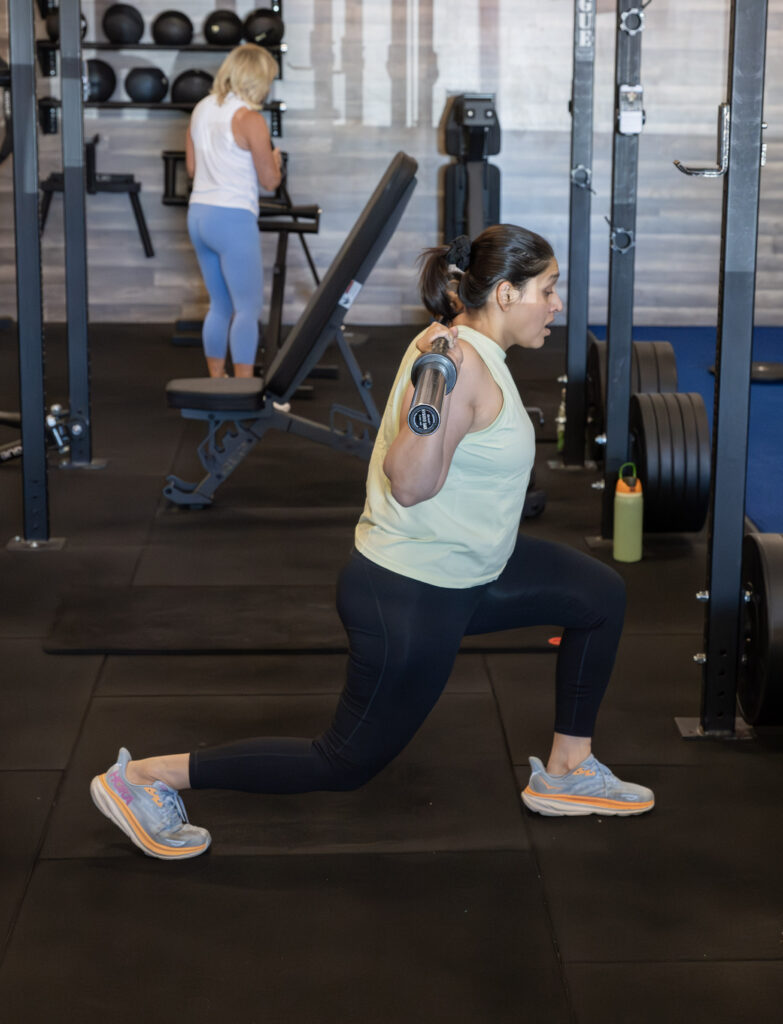
Knee pain over 40 is one of the most common complaints we hear, and if you’ve been dealing with it there’s a good chance you’ve been treating the wrong thing.
You’ve rested it. Iced it. Maybe had it looked at. Maybe been told to avoid squatting, avoid stairs, avoid anything that aggravates it. You’ve stretched your quads. You’ve worn a brace. You’ve modified around it for so long that you’ve almost accepted it as permanent.
Here’s what most people with chronic knee pain are never told: in the majority of cases, the knee is not where the problem originates. It’s where the problem shows up.
The origin is almost always above or below the knee — in weak hips, underactive glutes, or poor single-leg stability that forces the knee to absorb forces it was never designed to handle alone.
Treat the knee and the pain persists. Strengthen what’s actually causing it and the knee often improves without any direct treatment at all.
At Block Fitness, this is one of the most consistent patterns we see with new members. And watching someone’s chronic knee pain resolve as their hip strength improves — without anyone touching their knee — never gets old.
What’s Actually Happening in the Knee
The knee is a hinge joint. It is designed primarily to flex and extend — to bend and straighten. It is not designed to manage significant rotational or lateral forces on its own.
When the muscles above the knee — primarily the glutes, hip abductors, and deep hip rotators — are weak or underactive, those rotational and lateral forces fall to the knee instead. The knee compensates. It absorbs load it wasn’t built to absorb. Over time, that creates the chronic irritation, aching, and stiffness that most adults over 40 experience as “bad knees.”
The knee is doing its best with what it’s been given. The problem is that what it’s been given is insufficient support from above.
Similarly, weakness or instability at the ankle and foot — below the knee — changes how force travels up the chain during walking, stair climbing, and any single-leg activity. A foot that collapses inward on every step sends that collapse directly into the knee.
The knee is caught in the middle. Blamed for a problem it didn’t create.
The Research Is Clear
A 2015 study in the Journal of Orthopaedic and Sports Physical Therapy found that hip strengthening programs produced significant reductions in knee pain in adults with patellofemoral pain syndrome — one of the most common chronic knee complaints — without any specific knee treatment.
A 2019 systematic review in the British Journal of Sports Medicine confirmed that progressive resistance training targeting the hip and quadriceps musculature was among the most effective interventions available for chronic knee osteoarthritis — outperforming many passive treatments in long-term outcomes.
The mechanism is straightforward. Stronger glutes and hip abductors control femoral movement — the thigh bone — during walking, squatting, and stair climbing. When the thigh bone tracks correctly, the forces traveling through the knee joint are distributed properly. The irritation decreases. The pain follows.
The Movements That Actually Help Knee Pain Over 40
At Block Fitness, when a member arrives with chronic knee pain, the program doesn’t avoid loading the lower body. It loads it intelligently — starting with the movements that rebuild the hip strength the knee is missing.
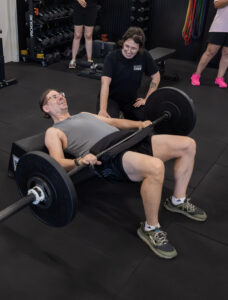
Glute bridges and hip thrusts. These isolate the glutes without placing significant compressive load on the knee. They rebuild the hip extension strength that underpins nearly every lower body movement. Most adults with knee pain discover their glutes are substantially weaker than they realized.
Lateral band work. Clamshells, lateral band walks, and side-lying hip abduction target the gluteus medius — the hip muscle most responsible for controlling knee position during single-leg activity. Strengthening it directly changes how the knee tracks during every step.
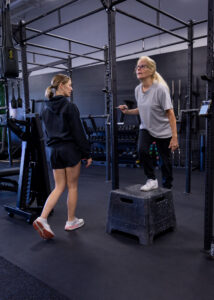
Controlled step-downs. Standing on a low box and slowly lowering the opposite foot toward the ground trains the quadriceps and glutes to absorb force eccentrically — the exact quality needed to control knee loading during stair descent and downhill walking. Done with a controlled tempo, this is one of the most effective knee rehabilitation exercises available.
Split squats and step-ups with support. As we covered in the balance and stability post, gripping a support hard during single-leg work uses irradiation to generate full-body tension — which stabilizes the hip and reduces the compensatory load on the knee. These exercises build single-leg strength in a way that transfers directly to the real-world movements that aggravate knee pain.
Hip hinge patterns. Romanian deadlifts and single-leg deadlifts build the posterior chain — glutes and hamstrings — that controls the knee from above. Members who build a strong hip hinge consistently report improvements in knee comfort during daily activity.
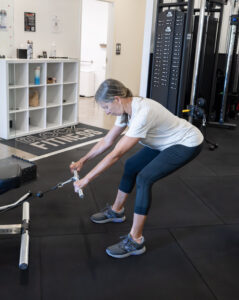
None of these exercises treat the knee directly. All of them change the mechanical environment the knee operates in. That is the difference.
What to Do About Pain During Training
A note worth making clearly: pain during training is information, not a stop sign.
Sharp, acute pain that appears suddenly during a movement is a signal to stop that movement and get it assessed. That’s appropriate caution.
Dull, chronic achiness that’s been present for months or years — the kind most adults with “bad knees” are managing — behaves differently. In most cases, intelligently selected and progressively loaded exercises do not aggravate it and often improve it within weeks.
The Block Fitness approach to pain during training follows a clear process: adjust form first, then load, then range of motion, then exercise selection. There is almost always a version of any movement that can be performed productively. We rarely tell members they can’t train a movement pattern. We find the entry point that works for them right now and build from there.
The goal is always to keep training. Movement, when applied intelligently, is medicine. Avoidance is rarely the answer — and for chronic knee pain specifically, avoidance of lower body loading often makes things worse over time by allowing the hip weakness that caused the problem to deepen further.
The Longer View
Most adults with knee pain over 40 have had it for years. They’ve normalized it. They’ve organized their life around it — avoiding certain activities, modifying their workouts, quietly accepting that their knees are just the way they are now.
We see something different at Block Fitness. We see adults in their 50s and 60s whose knee pain has been present for a decade resolve significantly within a few months of consistent, progressive hip strengthening. Not because we did anything extraordinary. Because we addressed the actual cause instead of managing the symptom.
If you are managing knee pain over 40, this matters: your knees are not inevitably broken. In most cases, they are under-supported. And under-supported structures respond to being given better support.
If you’ve been dealing with chronic knee pain and you’ve been told the answer is to avoid loading your lower body, we’d invite you to consider a different conversation about knee pain over 40.
Schedule a session at our Oro Valley or Catalina Foothills location and let’s find out what’s actually driving the pain — and build the strength that addresses it.
Move Better. Feel Better. Live Stronger.
Quick Take: FAQ
Q: Should I avoid squatting if my knees hurt?
A: Not necessarily. The issue is usually not the squat itself but the hip and ankle strength supporting it. A well-coached squat with appropriate load and depth is often one of the most therapeutic movements for chronic knee pain. The starting point matters — but avoidance is rarely the right long-term answer.
Q: How long before knee pain improves with hip strengthening?
A: Most adults notice meaningful improvements within six to ten weeks of consistent hip-focused training. The timeline varies based on how long the pain has been present and how consistent the training is.
Q: What if I’ve had a knee surgery or diagnosis — meniscus, ACL, arthritis?
A: These require individual assessment and, in some cases, clearance from your physician or physical therapist before loading. Block Fitness works regularly with post-surgical and diagnosed clients and coordinates with physical therapists when appropriate. A history of knee pathology changes the starting point, not the destination.
References
- Ferber R, et al. “Strengthening of the hip and core versus knee muscles for the treatment of patellofemoral pain: a multicenter randomized controlled trial.” Journal of Athletic Training. 2015.
- Fransen M, et al. “Exercise for osteoarthritis of the knee.” Cochrane Database of Systematic Reviews. 2015.
- Khayambashi K, et al. “Hip muscle strengthening and patellofemoral pain: a systematic review.” Journal of Orthopaedic and Sports Physical Therapy. 2015.
- Powers CM. “The influence of altered lower-extremity kinematics on patellofemoral joint dysfunction.” Journal of Orthopaedic and Sports Physical Therapy. 2003.
- McGill SM. Low Back Disorders: Evidence-Based Prevention and Rehabilitation. 3rd Edition. Human Kinetics.