
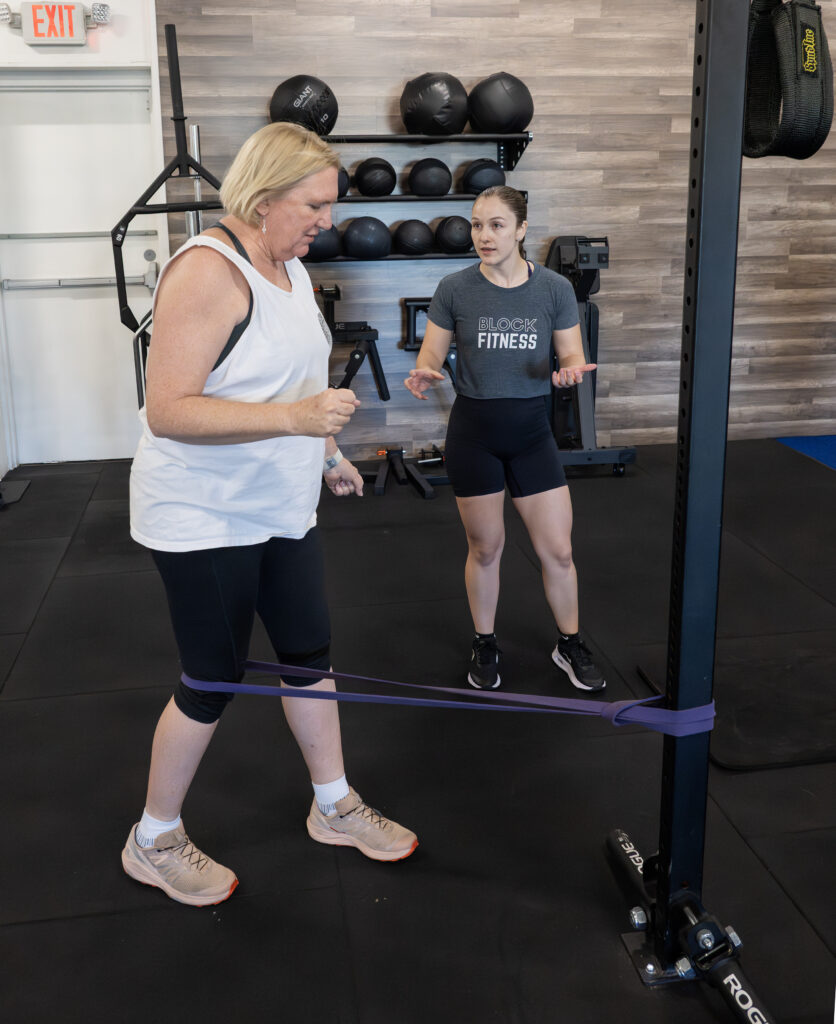
Mobility vs flexibility — these two terms are often used interchangeably in the fitness world, but they describe fundamentally different things. And confusing them leads adults over 40 to spend years stretching without ever resolving the stiffness, pain, and movement limitations they’re trying to fix. At Block Fitness in Tucson, we hear this almost daily: adults who stretch every morning, feel reasonably flexible, and yet still move poorly, hurt their backs, or feel unstable during exercise.
This post clears up the confusion. Whether you’re training in Tucson, Oro Valley, or the Catalina Foothills — and whether your goal is to move more easily, reduce pain, or improve athletic performance — understanding mobility vs flexibility will fundamentally change how you approach your warm-up, your training, and your recovery.
Mobility vs Flexibility: The Core Difference
Flexibility = Passive Range of Motion
Flexibility refers to how far a muscle can be passively lengthened — its ability to be placed into a range of motion by an external force. Think: how far can your hamstring stretch when someone lifts your leg? How far can you reach in a forward fold when gravity is doing the work?
Flexibility is largely a property of the muscle-tendon unit. You can be highly flexible (your tissues can achieve long ranges) while having poor mobility (you can’t control or use those ranges in movement).
Mobility = Active Range of Motion You Can Control
Mobility is the ability to actively move through a range of motion with control. It requires not just flexible tissues, but also strength, coordination, and neuromuscular control throughout the full range. A mobile hip joint can actively move into deep flexion and external rotation and maintain strength and stability throughout that range — not just be passively pushed there.
The key distinction: flexibility is passive capacity; mobility is active capability. You can have extensive flexibility but poor mobility. You cannot have excellent mobility without some degree of flexibility. But flexibility alone doesn’t create mobility — and chasing flexibility without mobility training is often why people feel “loose” but not stable.
Why Mobility Matters More Than Flexibility for Adults Over 40
For younger adults, excessive flexibility training without strength and control can cause problems. For adults over 40, the stakes are even higher. Here’s why mobility should be the priority:
Joint Stability Declines With Age
As we age, the tissues around joints — ligaments, tendons, cartilage — change in ways that can reduce passive stability. Adding more passive flexibility to an already less stable joint can increase injury risk, not reduce it. What you need is controlled range of motion — mobility — not simply more flexibility.
Movement Quality Determines Function
Your ability to perform daily activities safely — squatting, bending, reaching, carrying — depends on mobility, not flexibility. You don’t need passively flexible hamstrings to bend over and pick up a box. You need the ability to hinge at the hip with a neutral spine, maintain core tension, and load through the posterior chain with control. That’s mobility.
Strength Through Range Protects Joints
The National Institute on Aging emphasizes that maintaining strength throughout available ranges of motion is critical for joint health and injury prevention in older adults. This is exactly what mobility training develops — it bridges the gap between passive range and functional, load-bearing range.
What This Means for Your Training
Understanding mobility vs flexibility changes what you prioritize before training, during training, and in recovery work.
Warm-Up: Movement Over Stretching
Static stretching before training (holding a stretch for 30–60 seconds) can temporarily reduce force production and doesn’t improve mobility. A better warm-up focuses on active movement: leg swings, hip circles, thoracic rotations, band pull-aparts, and loaded stretching that builds control through range. This is standard in our semi-private training sessions at Block Fitness.
Training: Strengthen Through Range
The most effective mobility training is strength training through full range of motion. Deep goblet squats, Romanian deadlifts with full hip hinge, overhead press with full shoulder elevation — these build mobility because they develop strength and control throughout the movement pattern. Explore our strength training over 40 guide for exercises that develop both strength and mobility simultaneously.
Recovery: Active vs Passive Stretching
Passive stretching has value — it can reduce muscle tension, improve perceived recovery, and contribute to long-term flexibility gains over time. The CDC recommends flexibility and balance training as components of a complete fitness program for older adults. Just don’t confuse passive stretching with mobility work. Use both, but don’t substitute one for the other.
Common Mobility Limitations in Adults Over 40 — and What to Do
Hip Mobility
Hip mobility limitations are among the most common complaints at Block Fitness. Tight hip flexors, restricted hip external rotation, and limited hip extension all affect how you squat, hinge, lunge, and walk. The solution is not simply stretching the hip flexors — it’s building controlled range through all planes of hip motion with exercises like deep squats, hip 90/90 rotations, and single-leg training.
Thoracic Mobility
The mid-back (thoracic spine) is designed to rotate and extend, but becomes stiff in most adults who sit for long periods. Poor thoracic mobility forces the lower back to compensate, contributing to chronic lower back pain. Thoracic extension over a foam roller, cat-cow variations, and rotational rows all improve this critical area.
Ankle Mobility
Restricted ankle dorsiflexion (the ability to push your knee forward over your toes) is often the limiting factor in squat depth and quality. It also contributes to compensatory patterns in the knee and hip. Heel-elevated squats, calf stretching with loaded positions, and ankle circles in full range improve this pattern significantly.
Shoulder Mobility
Adults over 40 frequently experience shoulder stiffness from years of accumulated desk posture, repetitive use, or previous injuries. Band pull-aparts, face pulls, and overhead pressing variations with controlled loading improve shoulder mobility while simultaneously building the strength to stabilize the joint.
Frequently Asked Questions: Mobility vs Flexibility
Should I stop stretching and just do mobility work?
No — both have value. Passive stretching maintains and builds tissue length over time. Mobility work develops the strength and coordination to use that range. The best approach includes both: use passive stretching for recovery and long-term tissue adaptation, and active mobility work as part of your warm-up and training.
How much time should I spend on mobility work?
For most adults over 40, 10–15 minutes of dedicated mobility work before training and 10 minutes of passive stretching after training produces excellent results. Prioritize the specific areas that limit your movements: if your hip mobility limits your squat, target hips; if your thoracic spine limits your overhead press, target the upper back.
Can mobility work reduce chronic pain?
For many common pain patterns — particularly chronic low back pain, neck stiffness, and knee discomfort — improving mobility in the joints above and below the affected area significantly reduces pain. Hip mobility improvements frequently resolve lower back issues; thoracic mobility improvements often reduce neck and shoulder pain. This is well-supported in the physical therapy literature.
What’s the most important mobility exercise for adults over 40?
The Turkish Get-Up is often cited as the single best mobility exercise for adults over 40 — it develops hip, thoracic, shoulder, and ankle mobility simultaneously while building the strength and coordination to use that mobility. But more practically, the most important mobility exercise is the one that addresses your specific limiting factor. For most adults, that’s hip or thoracic mobility.
Is yoga a good substitute for mobility training?
Yoga is excellent for flexibility and passive range development. It’s less effective for the strength-through-range component that defines true mobility. If your yoga practice includes loaded, active movements (warrior progressions, balance work, strength-based flows), it can develop mobility. If it focuses primarily on passive stretching and held postures, it builds flexibility without necessarily building mobility. Both have value.
The Bottom Line
The mobility vs flexibility distinction matters because it determines how you train. Stretching makes you flexible. Mobility work makes you capable. For adults over 40 who want to move well, reduce pain, and stay strong through full ranges of motion — mobility is the priority, with flexibility as a supporting element. The goal isn’t to be loose. The goal is to be controlled.
At Block Fitness in Tucson — serving Oro Valley and the Catalina Foothills — mobility work is built into every training session. Because strength without range is limited. And range without strength is dangerous.
Move Better. Feel Better. Live Stronger.