
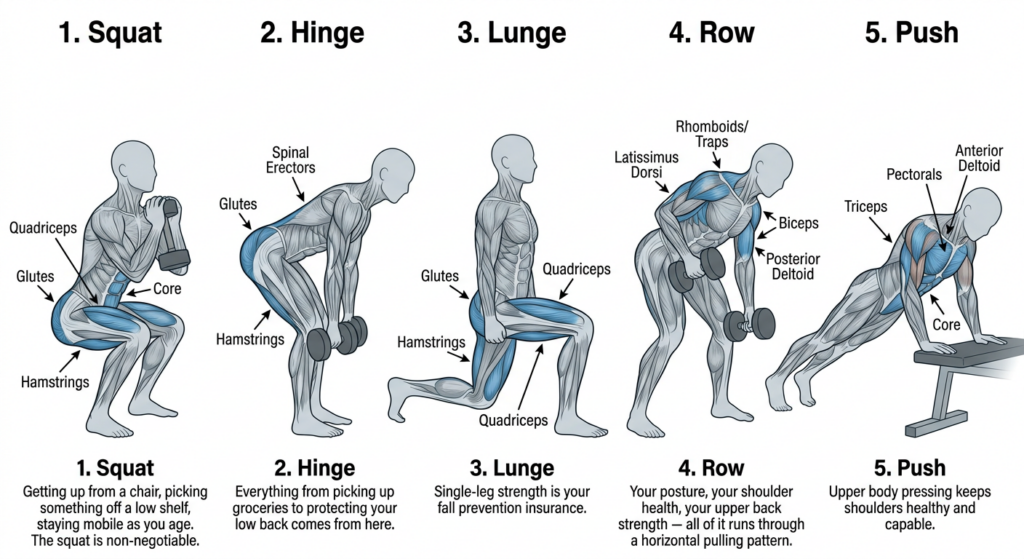
The 6 fundamental strength training movements are the foundation of every effective training program — and they’re especially important for adults over 40 who want to maintain function, strength, and independence as they age. At Block Fitness in Tucson, after coaching thousands of sessions with beginners, athletes, and adults well into their 70s, the answer to “what should I be training?” keeps coming back to the same six movement patterns. Not because they’re flashy. Not because they’re easy. Because they carry over to real life in ways that machine-based isolation exercises simply don’t.
If I could only train six movements for the rest of my life — whether I’m in Tucson, Oro Valley, or the Catalina Foothills — these would be them. This post explains what they are, why they matter, and how to apply them at any fitness level.
Why Movement Patterns Matter More Than Specific Exercises
Before listing the movements, it’s worth understanding why we organize training around patterns rather than individual exercises. Movement patterns are categories of human motion that appear repeatedly in daily life: sitting and standing, picking something up off the floor, pushing a door open, pulling yourself up from a chair, walking with a load, stepping up a curb. When you train these patterns, you’re not just building muscle — you’re building functional capacity.
The National Institute on Aging identifies functional movement ability — the capacity to perform daily activities independently — as one of the primary markers of healthy aging. Training the fundamental movement patterns is directly correlated with preserving this capacity.
The 6 Fundamental Strength Training Movements
1. Squat
The squat is the most fundamental lower-body movement pattern — a hip and knee flexion that mimics sitting, standing, and getting in and out of a car. Variations include goblet squats, front squats, back squats, box squats, and split squats. For adults over 40, the goblet squat and box squat are excellent starting points that protect the knees and lower back while building the quadriceps, glutes, and core.
Real-life application: Getting up from a chair, using stairs, squatting to pick something up, getting in and out of a car.
2. Hinge
The hip hinge — a movement that loads the posterior chain (glutes, hamstrings, lower back) through hip flexion with a neutral spine — is perhaps the single most important pattern for adults over 40. Deadlifts, Romanian deadlifts, kettlebell swings, and good mornings are all hinge variations. Strengthening the hinge is one of the most effective interventions for chronic low back pain and a critical component of injury prevention.
Real-life application: Picking things up from the floor, leaning forward at the waist, loading luggage, gardening.
3. Push
The push pattern covers horizontal and vertical pressing — pushing weight away from the body. Bench press, push-ups, dumbbell press, overhead press, and push press are all push variations. For adults over 40, maintaining shoulder health is crucial; starting with horizontal pressing (push-ups, chest press) before progressing to overhead pressing is usually wise.
Real-life application: Pushing open a door, getting up from the floor, pushing a grocery cart, lifting objects overhead.
4. Pull
The pull pattern is the complement to pushing — pulling weight toward the body. Rows, lat pulldowns, pull-ups, face pulls, and band pull-aparts all fall into this category. Most adults are relatively underdeveloped in the pulling muscles (upper back, rear deltoids, biceps), which contributes to poor posture and shoulder dysfunction. Prioritizing pulling work is particularly valuable for office workers and anyone who spends significant time seated.
Real-life application: Opening doors, pulling yourself up from the ground, rowing, carrying bags, hugging.
5. Lunge
The lunge pattern — single-leg loading — is the most underappreciated of the six movements. Walking lunges, reverse lunges, step-ups, Bulgarian split squats, and lateral lunges all train this pattern. Single-leg work addresses side-to-side imbalances, builds the stabilizing muscles around the knee and hip, and directly trains the movement pattern we use 100% of the time when we walk and climb stairs.
Real-life application: Walking, climbing stairs, stepping over obstacles, getting up from kneeling, hiking.
6. Carry
The loaded carry is the most underutilized fundamental movement — and one of the highest-value exercises for adults over 40. Farmer’s carries, suitcase carries, overhead carries, and Zercher carries build grip strength, core stability, shoulder health, and full-body conditioning simultaneously. They’re also among the most directly functional exercises you can do — because humans have been carrying things for their entire existence.
Real-life application: Carrying groceries, moving furniture, holding a child, traveling with luggage, yard work.
How to Build a Training Program Around These 6 Movements
A complete and effective training program doesn’t require dozens of exercises. Two to four sessions per week that include variations of all six fundamental strength training movements will produce comprehensive strength, functional capacity, and body composition improvements for most adults over 40.
A sample week might look like:
-
Day 1: Squat variation + Push variation + Carry
-
Day 2: Hinge variation + Pull variation + Lunge variation
-
Day 3: Full body circuit — one exercise from each pattern at moderate intensity
This template is adaptable to any fitness level, any equipment availability, and virtually any physical limitation. Explore our strength training over 40 programming guide for specific exercise progressions within each movement pattern. And if you want individualized coaching to build a program tailored to your body and goals, our semi-private training program at Block Fitness is designed exactly for this.
Why Compound Movements Beat Isolation Exercises for Adults Over 40
Isolation exercises — bicep curls, leg extensions, calf raises — train individual muscles. Compound exercises — squat, hinge, push, pull, lunge, carry — train multiple muscle groups working together. For time-pressed adults over 40, compound movements produce dramatically more return on investment: more muscle stimulated, more calories burned, more functional strength developed per minute of training.
Research consistently shows that compound movement training produces superior outcomes for muscle development, functional capacity, and long-term health markers in older adults compared to machine-based isolation training. The CDC’s physical activity guidelines specifically emphasize functional strength training that supports daily activities — which aligns directly with training these six fundamental patterns.
Frequently Asked Questions: Fundamental Strength Training Movements
Do I need a gym to train these six movements?
No. All six movements can be trained effectively with bodyweight alone, with minimal equipment (a set of dumbbells or kettlebells), or in a fully equipped gym. The movement patterns are what matter — the equipment is variable. A goblet squat, push-up, dumbbell row, reverse lunge, and farmer’s carry with grocery bags covers five of six with zero gym access.
What if I have pain or injury that limits certain movements?
Every movement pattern has dozens of variations, and virtually every limitation has a modification. Bad knees? There are squat variations that minimize knee stress. Bad shoulder? There are push variations that respect shoulder anatomy. Working with a coach is invaluable for identifying the right modification for your specific situation. We do this every day at Block Fitness in Tucson.
How many reps should I do of each movement?
Rep ranges depend on your goal. For general strength, 3–5 sets of 4–8 reps with heavy loads works well. For muscle building, 3–4 sets of 8–15 reps with moderate loads. For conditioning, circuits of 10–15 reps with lighter loads. All three approaches produce valuable adaptations for adults over 40, and rotating between them over time produces comprehensive results.
Is the carry really as important as squat or deadlift?
Arguably more so for adults over 40. The carry develops grip strength (strongly correlated with longevity), improves core and shoulder stability, trains breath control under load, and produces cardiovascular conditioning. Grip strength in particular has been identified in multiple studies as one of the strongest predictors of health span and lifespan in aging adults. Don’t skip the carries.
How long before I see results from training these movements?
Most adults notice meaningful strength improvements within 4–6 weeks of consistent training with these patterns. Visible body composition changes typically take 8–16 weeks. Functional improvements — feeling stronger in daily life, moving more easily, having better posture — often occur sooner and are frequently reported within the first few weeks of consistent training.
The Bottom Line
The 6 fundamental strength training movements — squat, hinge, push, pull, lunge, and carry — are all you need to build comprehensive strength, maintain functional capacity, and support lifelong health. Strip away the fitness industry noise, and these patterns are what remain. They’re time-tested, evidence-supported, and adaptable to any body and any fitness level.
At Block Fitness in Tucson — serving Oro Valley and the Catalina Foothills — these six patterns are the foundation of every program we build. Simple, purposeful, effective.
Move Better. Feel Better. Live Stronger.