
You’ve thought about joining a gym. Maybe more than once.
You’ve told yourself you’ll start when you lose a little weight first. When you know what you’re doing. When you feel ready.
But that moment never quite arrives.
If that sounds familiar, you’re not alone — and you’re not weak. What you’re experiencing has a name, a measurable psychological mechanism, and a real impact on your health. Researchers call it gymtimidation: the anxiety, self-consciousness, and fear of judgment that keeps millions of people from ever walking through a gym door.
This post is going to explain exactly why it happens, what the research says, how to start overcoming it, and why Block Fitness was built — intentionally — as an environment where it doesn’t have to stop you anymore.
What Is Gymtimidation? (And Why It’s Not Just In Your Head)
Gymtimidation describes the anxiety and social fear many people feel in gym environments. It includes:
- Fear of being judged for your body, fitness level, or technique
- Feeling out of place or like you don’t belong
- Worry that others are watching and silently evaluating you
- Avoidance of equipment, areas, or exercises because you don’t know how to use them
- Shame or embarrassment around your appearance in workout clothing
- Feeling like the gym is “for other people” — athletic, young, already fit
A 2019 survey by Mindbody found that 65% of women and 36% of men avoid the gym because they’re afraid of being judged. A separate study by the fitness platform Hussle found that 50% of non-gym-goers cited fear of judgment as a primary reason for not joining. These aren’t fringe feelings. They are statistically dominant barriers to exercise participation.
And they have real consequences. Not just for self-esteem — but for long-term health.
“The fear of being judged at a gym is stopping more people from exercising than almost any other factor. It’s not a motivation problem. It’s an environment problem.”
The Psychology Behind Gym Anxiety: What’s Actually Happening in Your Brain
Gymtimidation isn’t irrational. It’s a predictable response to a specific social environment. Understanding the psychological mechanisms behind it helps you stop blaming yourself — and start addressing the real problem.
1. Social Comparison Theory
Leon Festinger’s Social Comparison Theory (1954) explains that humans instinctively evaluate themselves against others, especially in ambiguous or performance-based settings. Gyms are prime territory for this. They are visually driven environments — mirrors, bodies, weights, performance — and they activate comparison constantly.
When someone who is deconditioned or new to training walks into a room full of people who appear athletic, lean, or experienced, their brain immediately begins benchmarking. That comparison rarely favors the newcomer, because they’re comparing their beginning to someone else’s years of work.
2. The Spotlight Effect
Research by Thomas Gilovich and colleagues at Cornell found that people dramatically overestimate how much others are noticing them. In studies, participants believed their behavior or appearance was observed far more frequently than it actually was.
In a gym, this translates directly: new members feel certain that experienced lifters are watching, judging, or commenting — when in reality, most people are entirely focused on their own training. The spotlight effect makes the gym feel like a stage when it’s actually just a room full of people doing their own work.
3. Objectification Theory and Body Image
Psychologist Barbara Fredrickson’s Objectification Theory describes how people — especially women — are socialized to view their bodies as objects to be evaluated by others. This “self-objectification” causes individuals to monitor their own appearance constantly and to feel shame or anxiety when they believe they fall short of cultural ideals.
Gyms, particularly commercial fitness spaces filled with mirrors, marketing imagery, and performance culture, intensify this dynamic significantly. The result: people who most need the health benefits of exercise are precisely the people most likely to feel too exposed to pursue it.
4. Exercise Self-Efficacy
Self-efficacy — your belief in your ability to succeed at a task — is one of the strongest predictors of exercise behavior. Research by Albert Bandura consistently shows that people with low exercise self-efficacy avoid physical activity because they don’t believe they can do it competently.
This creates a painful loop: the people who need to build strength and physical confidence the most are also the people who feel least equipped to pursue it in a gym environment. Without a structured, supportive, and education-first environment, that loop is very hard to break.
5. Fear of Negative Evaluation (FNE)
Fear of Negative Evaluation is a well-documented social anxiety construct in which individuals are preoccupied with the possibility that others will judge them negatively. Studies published in the Journal of Sport and Exercise Psychology have linked high FNE scores directly to gym avoidance, lower exercise frequency, and reduced willingness to try new movements or use unfamiliar equipment.
This fear isn’t abstract. It shapes concrete behavior: people avoid the weight room entirely, stick to cardio machines in the back of a facility, skip sessions when they’re having a bad body image day, or quit memberships altogether rather than face the anxiety again.

The Real Cost of Gymtimidation
Avoiding the gym because of fear isn’t a neutral outcome. It has measurable health consequences.
The research on strength training — especially for adults over 40, 50, and 60 — is unambiguous. Resistance training reduces all-cause mortality risk, preserves muscle and bone density, improves balance and fall prevention, reduces chronic pain, supports metabolic health, and protects cognitive function as we age.
When gymtimidation keeps someone from consistent exercise, the cost isn’t just a missed workout. It’s cumulative muscle loss. Increased injury risk. Reduced independence. A narrowing of physical capacity that accelerates with age and gets harder to reverse.
The barrier isn’t willpower. The barrier is environment.
How to Overcome Gymtimidation: Evidence-Based Steps
These aren’t motivational clichés. These are strategies grounded in behavioral science that actually reduce the psychological barriers to consistent exercise.
Step 1: Recognize That the Fear Is Normal — And Shared
The first step is stopping the shame spiral around the fear itself. Gymtimidation is not a personal failure. It is a documented, statistically common response to a specific kind of social environment. When you understand that most people who walk into a new gym feel some version of what you feel, the experience becomes less isolating and more manageable.
Step 2: Choose the Right Environment First
Not all gyms are equal. The research is clear that perceived social climate — how welcoming, non-judgmental, and competency-supportive a fitness environment feels — significantly predicts exercise adherence. A large commercial gym with loud music, visible mirrors, and a culture built around aesthetics is an objectively harder environment for someone with gym anxiety.
Smaller, coaching-driven environments where you are known by name, given an individualized plan, and not expected to figure things out alone are measurably better entry points for people with high gymtimidation. The environment choice matters as much as the decision to exercise.
Step 3: Focus on Competency, Not Comparison
One of the most effective evidence-based strategies for reducing gym anxiety is shifting from a performance goal orientation (how do I compare to others?) to a mastery goal orientation (am I getting better at this?). When progress is defined by your own baseline — not by the person next to you — the psychological experience of training changes fundamentally.
This is why programs that provide visible, measurable, individual progress data are dramatically better for long-term adherence among people with gymtimidation than open, unstructured gym access.
Step 4: Start With Coaching, Not Just Access
Unsupervised gym access is one of the worst starting points for someone with gym anxiety. Not knowing what to do amplifies every fear. You feel conspicuous, uncertain, and exposed. A coach changes the dynamic entirely — you have direction, feedback, and someone who knows you and your goals. The cognitive load drops and the experience becomes learning, not performing.
Step 5: Accumulate Small Wins Early
Self-efficacy — your belief that you can do this — is built through direct mastery experiences. Small, consistent wins early in the process are the most powerful antidote to gym anxiety. When you complete a workout, learn a movement correctly, or add weight to a lift, your brain registers competence. That registration, repeated over time, rewrites the story you tell yourself about what you are capable of.
Step 6: Give Your Nervous System Time
Habit formation research suggests that a new behavior becomes automatic after roughly 60 to 90 repetitions in context. The first several weeks of training are neurologically the hardest — not because the exercises are impossible, but because the environment is still unfamiliar. Committing to a minimum of six to eight weeks before evaluating how you “feel” about training gives your nervous system time to normalize the experience.
Why Block Fitness Was Built for People Who’ve Felt This Way
Everything above is the science. Here’s the reality of what that means in practice at Block Fitness — and why our model addresses gymtimidation at every layer, not just on the surface.
No Mirrors. No Accidental Comparison.
We don’t have mirror-lined walls. That’s intentional.
Mirrors in a gym are there to enable self-monitoring and comparison. For someone with body image concerns or gym anxiety, they are a constant source of self-evaluation that pulls attention away from training and toward appearance. Our environment is designed around movement and performance — not reflection.
When you train at Block Fitness, you’re focused on how the lift feels, how your form is progressing, and what you’re building. Not on what you look like doing it.
No “Keep Up.” Your Program Is Yours.
In a traditional group fitness class, everyone does the same workout at the same time. If you can’t keep up — in weight, reps, speed, or complexity — it’s visible. You feel it.
Block Fitness uses a semi-private model where every client follows an individualized program. Your plan is based on your goals, your injury history, your movement quality, and your current capacity. No one in the room is doing the same workout you are.
That means there is no keeping up. There’s only your plan.
The woman next to you might be squatting 135 pounds. You might be working on goblet squats with a 20-pound kettlebell. Neither of you is behind. Both of you are exactly where your program says you should be.
Coaching That Teaches, Doesn’t Shame
Shame is not a coaching tool. It never produces lasting change. It produces avoidance.
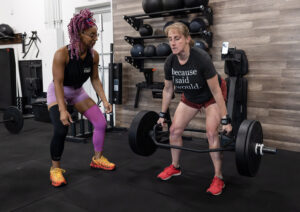
Block Fitness coaches are trained to observe, correct, and educate — not to judge. When a movement needs adjustment, the conversation is about biomechanics and function, not about what you’re doing wrong. Corrections are delivered as information, not criticism.
Our clients — many of whom have decades of experience feeling self-conscious about their bodies or their fitness level — consistently describe our coaching environment as the first place they’ve felt genuinely coached rather than watched.
We teach you why an exercise is structured the way it is, how it connects to your goals, and how to know when it’s working. That kind of education builds the competency and self-efficacy that research shows is essential for long-term adherence.
You’re Known Before You Start
Every Block Fitness member goes through an assessment before they begin training. Not as a sales hurdle — as a genuine diagnostic conversation about your goals, your history, your limitations, and what success actually looks like for you.
By the time you train your first session, your coach already knows:
- What you’ve struggled with before and why
- Where your body has pain or limitation
- What you’re working toward and what matters to you
- What movements to modify, and how
You don’t walk in as a stranger. You walk in as someone with a plan built specifically for them.
The People in the Room Look Like You
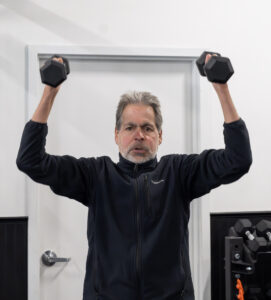
Many of our members are adults in their 40s, 50s, 60s, and beyond. Many started with no training background. Some came to us after joint replacements, back surgeries, or decades of inactivity. Some came after years of trying and quitting in environments that didn’t work for them.
You will not walk into Block Fitness and feel surrounded by 25-year-olds lifting twice your bodyweight and looking like they belong in a fitness magazine. You’ll find people who are doing the work because they’ve decided their health is worth prioritizing — at every starting point, every age, and every level.
That changes the experience entirely.
Progress Is Visible and Yours
One of the most powerful antidotes to gymtimidation is watching yourself get better.
Because your program is individualized and tracked, progress is measurable and visible. You’ll know when your deadlift improved. You’ll know when a movement that used to feel impossible now feels controlled. You’ll feel the difference in how you climb stairs, carry groceries, or move through your day.
That feedback loop — seeing and feeling real progress — is what transforms a gym from a place you dread into a place you come back to.
The Bottom Line
Gymtimidation is real. The psychology behind it is well-documented. And it keeps too many people — people who genuinely need and want to feel stronger, healthier, and more capable — from ever getting started.
The answer isn’t to push through a bad environment. The answer is to find an environment built differently.
Block Fitness was designed from the ground up for people who want real coaching, not performance pressure. Who need an individualized plan, not a one-size-fits-all class. Who are tired of feeling like the gym isn’t for them — and are ready for a place where it actually is.
“The gym doesn’t have to feel the way it’s always felt. You deserve to train in an environment that’s built for the way you actually are — not the way you think you’re supposed to be.”
If gymtimidation has kept you from starting — or from going back — we want to talk to you. Not to sell you something. To show you what training looks like when the environment is built around your success.
Schedule a free consultation at Block Fitness in Tucson. We’ll walk you through our process, answer every question, and build you a plan that actually fits you.
You’ve waited long enough.
Frequently Asked Questions About Gymtimidation
What is gymtimidation?
Gymtimidation is the anxiety, self-consciousness, and fear of judgment that many people feel in gym environments. It commonly includes fear of being watched or evaluated, feeling out of place, not knowing how to use equipment, and embarrassment about body image or fitness level. Research shows it affects the majority of adults who avoid gyms.
Is gym anxiety a real psychological condition?
Gym anxiety is a real and well-documented psychological response, rooted in Social Comparison Theory, the Spotlight Effect, Fear of Negative Evaluation, and low exercise self-efficacy. While it is not a formal clinical diagnosis, the mechanisms behind it are the same as those studied in social anxiety research. It is extremely common and completely valid.
How do I overcome fear of going to the gym?
Evidence-based strategies include: choosing a smaller, coaching-driven environment rather than a large commercial gym; starting with professional guidance so you know what you’re doing; focusing on personal mastery rather than comparison; accumulating early wins to build confidence; and giving yourself at least six to eight weeks for the environment to feel familiar.
What kind of gym is best for people with body image concerns?
Environments without mirrors, with individualized rather than group programming, staffed by coaches who teach rather than evaluate, and populated by a diverse range of ages and body types tend to dramatically reduce gym anxiety. Semi-private training models — like what Block Fitness offers — are particularly effective because you receive personalized coaching in a small, low-pressure setting.
Does Block Fitness have mirrors?
No. Block Fitness does not have mirrors lining the walls. The environment is intentionally designed around coaching quality and performance rather than appearance monitoring.
Is Block Fitness good for beginners or people who haven’t worked out in years?
Yes. Many of our members started with no training background or returned to exercise after years away — including after injuries, surgeries, or long periods of inactivity. Every member receives an individualized program built around their actual starting point. There is no “catching up” required.
Written by the coaching team at Block Fitness | Oro Valley & Catalina Foothills, Tucson, AZ
Block Fitness is a coaching-driven, semi-private strength training gym serving adults in Tucson, Arizona. We specialize in individualized programming, pain-informed coaching, and building long-term physical capability for real life.