
Food labels are designed to confuse you.
Serving sizes that don’t match reality. Health claims that mean nothing. Ingredients buried so deep in the list you’d need a chemistry degree to recognize them.
Most people are making daily nutrition decisions based on marketing — not information.
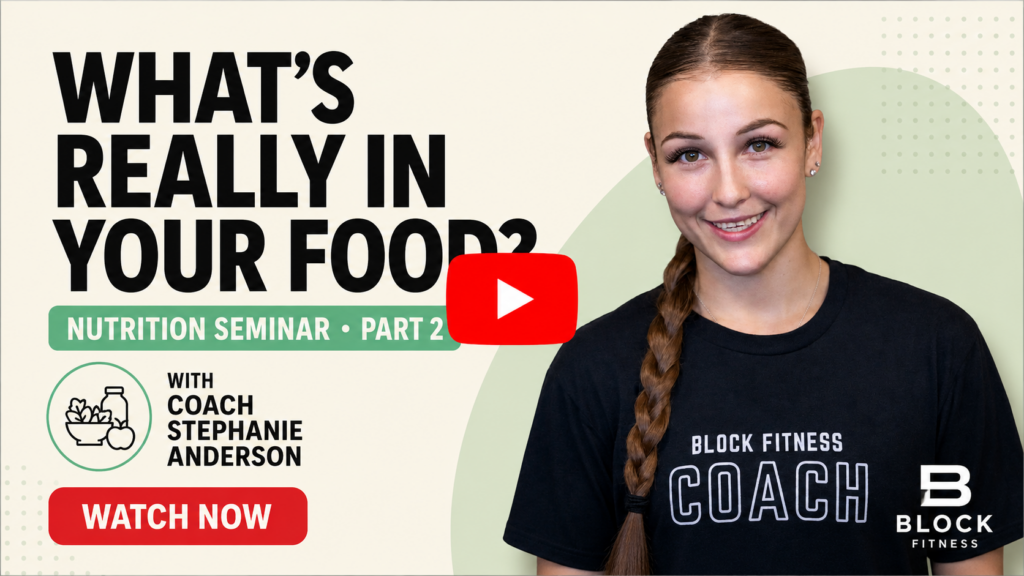
Coach Stephanie hosted a live seminar at Block Fitness Catalina Foothills to change that. In one hour she covers what the labels actually mean, how to read your macros without getting misled, and what to stop falling for at the grocery store.
No fluff. No diet dogma. Just clear, practical nutrition education from a coach with a B.S. in Nutrition and Human Performance who works with real people every day.
The full seminar is below. Watch it once and you’ll never read a food label the same way again.
Watch The Nutrition Seminar…
What You’ll Learn About Food Labels in This Seminar
Coach Stephanie spends the first part of the session on a skill most people skip entirely: actually reading the label instead of just skimming the front of the package. Here’s a preview of what’s covered before you press play.
- Serving size math: how a package can double or triple the real serving size so the calorie count on food labels looks smaller than what actually lands on your plate.
- Sugar’s secret names: the long list of ingredient words that all mean added sugar, even when the word “sugar” never appears on the ingredient list itself.
- Marketing words versus regulated claims: why “natural,” “light,” and “multigrain” are marketing choices, not proof of anything healthier.
- Macro reading in under 30 seconds: a repeatable way to scan protein, carbs, and fat without needing a nutrition degree.
- A two-minute grocery store checklist you can use on your very next shopping trip.
Why Food Labels Are Easier to Misread Than You Think
Food labels are regulated, but regulation doesn’t mean the information is laid out in a way that’s easy to use in real life. The layout, the rounding rules, and the definitions behind certain claims all favor the brand on the shelf, not the shopper standing in the aisle trying to make a fast decision.
That’s exactly why so many careful, health-conscious people still get tripped up — the confusion is a design problem, not a personal failure. Coach Stephanie built this seminar around that idea: give people a repeatable process for reading the label, instead of a list of foods to fear. If nutrition strategy is a topic you want to go deeper on, you can browse more nutrition breakdowns on the blog.
Quick Food Label Terms Cheat Sheet
Keep these definitions handy next time you’re comparing food labels side by side in the store:
- Serving size: the amount used to calculate every other number on food labels, not necessarily the amount you’ll actually eat.
- Percent Daily Value: how much one serving contributes to a 2,000-calorie diet, useful for comparison but not a hard limit.
- Added sugars: sugar that didn’t occur naturally in the food, broken out as its own line on food labels since 2020.
- Dietary fiber: counted inside total carbs, and often subtracted when people estimate net carbs.
Turn What You Learn Into a Plan
Watching the seminar is the first step. Coach Stephanie works with Block Fitness members every week to turn food labels knowledge into a nutrition approach that actually fits their schedule, training goals, and food preferences, not a generic meal plan pulled from the internet. If you want that kind of support, reach out to our coaching team and mention this seminar. For the official breakdown straight from regulators, the FDA’s guide to the Nutrition Facts label is a solid reference to keep bookmarked.