
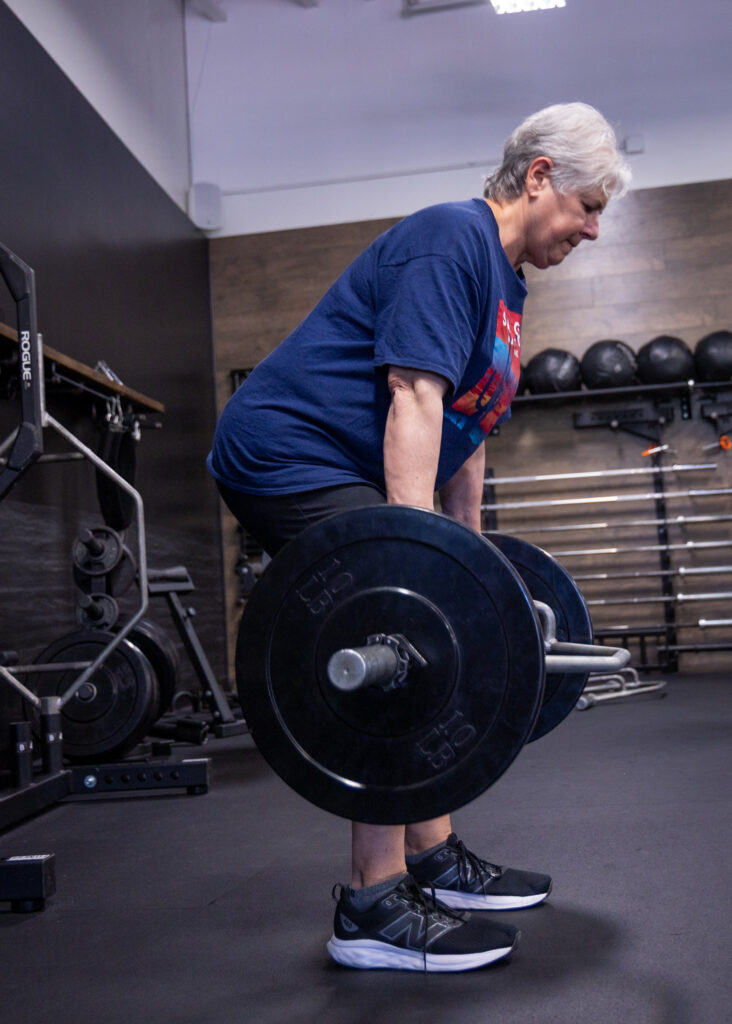
When you deadlift consistently, your body changes in ways most people never expect. Most conversations about the deadlift focus on how to do it.
This one is about what happens when you do it — consistently, progressively, over the course of a full year.
Because the short-term benefits of any exercise are one conversation. The long-term physiological changes that accumulate when a movement becomes a sustained practice are a different and more important one. Especially for adults over 40, whose bodies respond not just to individual training sessions but to the patterns those sessions create over months and years.
At Block Fitness, we’ve coached the deadlift with adults across Oro Valley and the Catalina Foothills long enough to see what a year of consistent pulling actually produces. The research confirms what we observe in the gym every day.
Here’s what changes.
Your Posterior Chain Becomes a Different Animal
The posterior chain — glutes, hamstrings, spinal erectors, upper back — is the engine of the deadlift. It is also one of the most underused muscle groups in modern sedentary life, where most adults spend hours seated, hip flexors shortened, glutes disengaged, posterior chain doing almost nothing productive.
A year of consistent deadlifting reverses that pattern comprehensively.
The glutes develop the capacity to generate force they haven’t produced in years. The hamstrings learn to work under load through their full range. The spinal erectors build the endurance to maintain position under tension, which directly translates to how the lower back handles everything from sitting at a desk to lifting a bag of luggage overhead.
This is not a subtle change. Members who have trained the deadlift consistently for twelve months move differently. They stand differently. They pick things up differently. The posterior chain that was dormant becomes the foundation everything else is built on.
Your Bone Density Improves
This is the benefit most people never think about — and one of the most important, particularly for women over 50.
Bone tissue responds to mechanical load the same way muscle does: it remodels in response to stress, becoming denser and stronger over time. The deadlift places substantial compressive and tensile load on the lumbar spine, hips, and legs — exactly the sites most vulnerable to osteoporotic fracture in older adults.
A 2018 study published in the Journal of Strength and Conditioning Research found that progressive deadlift training produced significant improvements in lumbar spine bone mineral density in postmenopausal women over a sixteen-week period. Sixteen weeks. The adaptations that accumulate over a full year are meaningfully greater.
Strength training is the most effective non-pharmacological intervention for bone health available to older adults. The deadlift, as a loaded hip hinge involving the entire posterior chain and spine, is one of the best strength training tools for driving that adaptation.
Your Lower Back Gets Stronger — And Often Hurts Less
This surprises people who came in believing the deadlift would hurt their back.
The research tells a different story. A well-coached, progressively loaded deadlift builds the exact musculature that supports and protects the lumbar spine. The spinal erectors, the multifidus, the quadratus lumborum — these are the muscles that stabilize the spine during every movement of daily life. When they’re strong, the spine is supported. When they’re weak, it isn’t.
A 2015 study in the Journal of Strength and Conditioning Research found that deadlift training produced significant reductions in pain and disability in patients with chronic low back pain — outperforming conventional physical therapy in several outcome measures.
We have watched this happen repeatedly at Block Fitness. Members who arrived with years of chronic low back discomfort, who had been told to avoid heavy lifting, who were skeptical that a barbell could help rather than hurt — found that twelve months of progressively loaded hip hinge work changed the relationship they had with their lower back entirely.
The movement that seemed like the risk turned out to be the remedy.
Your Grip Strength Reaches a New Level
Grip strength is one of the most reliable predictors of overall health and longevity in older adults. The Lancet study following over 140,000 people across 17 countries found it was a stronger predictor of cardiovascular mortality than blood pressure.
The deadlift is one of the most effective grip-strengthening exercises that exists. Every rep requires maintaining tension through the hands, wrists, and forearms under significant load. A year of consistent pulling produces grip strength that shows up everywhere — opening jars, carrying groceries, holding onto a grandchild, swinging a golf club, staying stable during a fall.
It is a small thing that turns out to matter enormously.
Your Confidence in Your Body Changes
This one doesn’t show up in research papers. But it is real, and it is one of the most consistent things we observe at Block Fitness in members who have committed to the deadlift over time.
There is something that happens when a person learns to pick up something heavy from the floor with control, intention, and strength. It changes how they experience their body. Not in an ego-driven way. In a quiet, grounded way.
They stop feeling fragile. They stop bracing themselves against normal physical demands. They start trusting their body to handle things — because they’ve spent a year proving that it can.
That shift in confidence is not a side effect of deadlift training. It is one of the central outcomes. And it is available to every adult who commits to the movement long enough to earn it.
Come Experience It Tomorrow
The Deadlift Classic is at our Oro Valley location tomorrow, August 22nd.
This event is not for elite powerlifters. It is for adults who have trained the deadlift, are learning it, or are curious about what it can do for them. It is a community event built around one of the most important movements a human body can learn to perform well.
We would love to see you there. Details and registration at blockfitco.com or reach out directly: orovalley@blockfitco.com | 520.317.7409.
Move Better. Feel Better. Live Stronger.
Quick Take: FAQ
Q: How long before deadlifting consistently changes how I feel day to day?
A: Most people notice meaningful differences in how their back feels during daily activities within eight to twelve weeks of consistent training. The changes compound significantly over six to twelve months.
Q: Do I need to deadlift heavy to get these benefits?
A: No. The benefits described above — bone density, posterior chain strength, back health, grip strength — accumulate in response to progressive loading relative to your current capacity. Moderate loads that challenge you are enough. Heavy is relative.
Q: What if I’ve never deadlifted before?
A: That is the ideal time to start. Learning the movement correctly from the beginning, with a coach who can establish the pattern before load is added, produces the best long-term outcomes. Block Fitness coaches teach this movement every day to adults at every level of experience.
References
- Berglund L, et al. “Which patients with low back pain benefit from deadlift training?” Journal of Strength and Conditioning Research. 2015.
- Welch N, et al. “The effects of a free-weight-based resistance training intervention on pain, squat biomechanics and MRI-defined lumbar fat infiltration.” Journal of Strength and Conditioning Research. 2015.
- Leong DP, et al. “Prognostic value of grip strength.” The Lancet. 2015.
- Watson SL, et al. “Heavy resistance training is safe and improves bone, function, and stature in postmenopausal women with low to very low bone mass.” Journal of Bone and Mineral Research. 2018.