
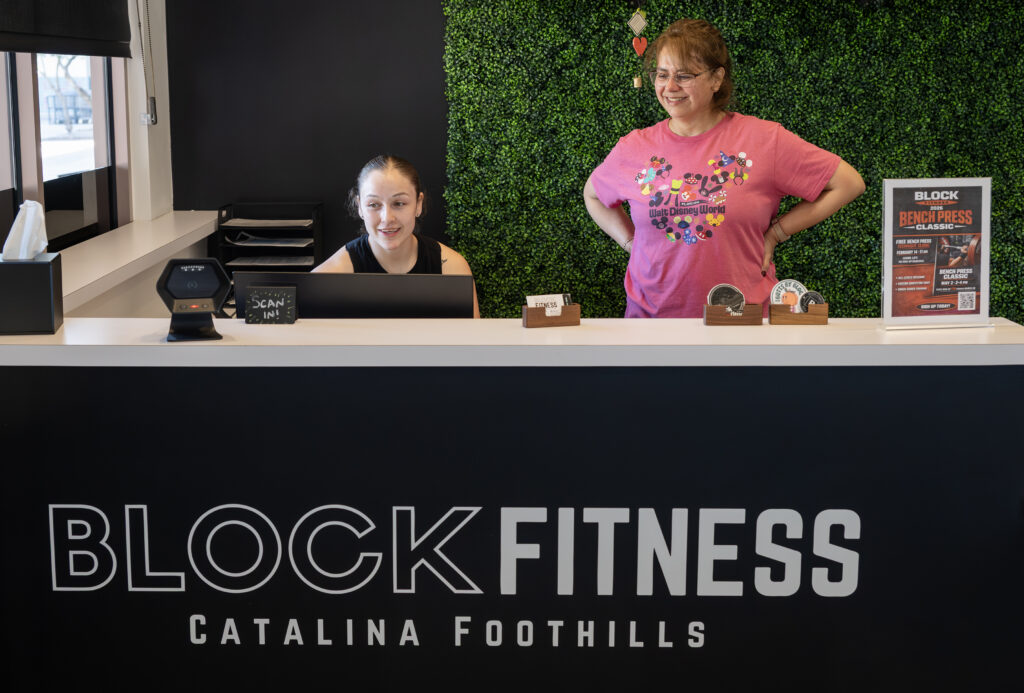
Building healthy habits for fitness is not about willpower. It’s not about motivation. And it’s definitely not about forcing yourself to do things you hate until they become automatic. At Block Fitness in Tucson, we’ve coached adults over 40 through this exact challenge for years — and what we’ve learned from both the research and the gym floor is that most people’s understanding of what a habit actually is gets in the way of building one.
This post is the honest version of the habit conversation: what habits really are, why the typical advice fails adults over 40, and what actually works for building healthy habits that last in Tucson, Oro Valley, and the Catalina Foothills — through the demands of real adult life.
What a Habit Actually Is (Not What Most People Think)
When most people say “habit,” they mean a routine they do consistently. But that’s not what a habit is at the neurological level. A habit is a behavior your brain has automated — something you do without conscious deliberation. Automatic. Reflexive. Below conscious awareness.
The formal definition from behavioral psychology: a habit is a learned behavior that becomes automatic through repetition and environmental cues. The key word here is automatic. True habits don’t require motivation because they don’t require conscious decision-making. They’re triggered by environmental cues and executed without deliberate effort.
This distinction matters because most “habit-building” advice tells you to repeat a behavior until it becomes automatic — but skips the environmental design component that actually makes automaticity possible. You can repeat a behavior for months and never build a true habit if the environmental cues aren’t in place.
Why Building Healthy Habits Is Harder After 40
Adults over 40 face specific challenges that make habit formation more complex than it was in their 20s:
Established Competing Routines
The longer you’ve lived, the more deeply ingrained your existing routines are. Your mornings, evenings, and weekends have established behavioral scripts. Inserting a new behavior requires either displacing an existing one or finding genuinely unoccupied time — both of which are harder than they sound.
Higher Life Demands
Work, family, caregiving, health management, social obligations — these don’t get lighter with age. Building healthy habits for fitness has to compete with everything else, which means the behaviors need to be both low-friction and high-value. You can’t build a habit that requires three hours of preparation for a 45-minute workout.
Previous Failed Attempts
Most adults over 40 have tried to build fitness habits before — and experienced failure cycles that have created a certain skepticism about their own follow-through. This psychological residue is real and can undermine new attempts even when the conditions are genuinely different. Addressing this history honestly is part of building something that sticks.
What Actually Works: Evidence-Based Habit Formation for Adults Over 40
1. Design Your Environment Before Designing Your Schedule
James Clear’s work on atomic habits — supported by decades of behavioral psychology research — consistently shows that environmental design is a stronger predictor of habitual behavior than intention, motivation, or willpower. If you have to fight friction to exercise, you will lose that fight on hard days. If exercise is the path of least resistance, you’ll do it without thinking.
Practical applications: keep your gym bag packed and visible, schedule training at a gym close to your commute route, join a program where showing up for others creates social accountability, make it physically easier to exercise than not to. Our semi-private training program at Block Fitness is built around exactly this: scheduled sessions, a community that notices your absence, and a gym in the Tucson area that makes showing up simple.
2. Use Identity-Based Motivation, Not Outcome-Based Motivation
Outcome motivation — “I want to lose 20 pounds” — works initially but collapses when progress slows. Identity motivation — “I’m someone who trains three times a week” — is fundamentally more durable because it’s tied to who you are, not what you want to achieve.
The research on identity and behavior is clear: behaviors that align with your self-concept are significantly more likely to become automatic. Start saying “I train” instead of “I’m trying to get in shape.” Vote for the identity with every rep, every session, every time you show up on a hard day.
3. Habit Stack — Attach New Behaviors to Existing Ones
Habit stacking (popularized by BJ Fogg and James Clear) is the practice of linking a new desired behavior to an existing automatic behavior. “After I put the kids to bed, I lay out my gym clothes for tomorrow.” “When I get to the parking lot at work, I do five minutes of mobility work in my car.” New habits attach to existing neural grooves more easily than they form independently.
4. Start Smaller Than You Think Is Necessary
The most common mistake in building healthy habits for fitness is starting at a level that requires maximum motivation to maintain. Start with two sessions per week, not five. Start with 30 minutes, not 90. Make the starting threshold so low that not doing it would feel almost absurd. The National Institute on Aging specifically recommends starting physical activity programs gradually and building incrementally — because this approach produces better long-term adherence than aggressive starts. Explore our strength training over 40 resources for low-threshold starting points.
5. Track the Process, Not Just the Outcome
Tracking behavior (sessions completed, days per week trained, consistency streaks) provides immediate reinforcement that outcomes — which take weeks or months to become visible — cannot. The CDC’s physical activity recommendations for adults are expressed in weekly frequency and minutes per week for exactly this reason: frequency and consistency are the behaviors that matter, not any single session’s intensity.
The Environment Trap: Why Willpower Fails Every Time
Here’s the core insight from decades of behavioral research: willpower is a limited, depletable resource. People who appear to have great willpower typically have great environmental design — their choices are structured in ways that rarely require willpower at all.
If building healthy habits for fitness requires fighting your environment every day — if your gym is inconvenient, your schedule unpredictable, your support system absent, and your alternatives easier and more immediately rewarding — no amount of willpower will sustain the behavior long-term. Design the environment first. Let the habits form naturally from reduced friction.
Frequently Asked Questions: Building Healthy Habits for Fitness
How long does it really take to build a habit?
The popular “21 days” figure is largely a myth — research suggests habit formation takes anywhere from 18 to 254 days, with an average around 66 days for exercise-related behaviors. The variability depends on the complexity of the behavior, consistency of the environmental cues, and how much the behavior aligns with your existing routines and identity. Expect 2–3 months of deliberate effort before a training habit becomes genuinely automatic.
What if I keep falling off my routine?
Every fall is data. The question isn’t “why did I fail?” but “what made this hard?” Examine the friction points: was the schedule unrealistic? Was the gym inconvenient? Was the intensity too high? Adjust one thing at a time. The adults who build lasting habits aren’t the ones who never fall off — they’re the ones who get back on quickly and use each disruption to improve the system.
Is accountability from others really that important?
For most adults, external accountability is one of the strongest drivers of adherence. Research consistently shows that social support, whether from training partners, coaches, or communities, significantly improves long-term consistency compared to training alone. This is a core reason our semi-private training model produces better outcomes than solo gym membership for most adults over 40.
Can building healthy habits for fitness change other areas of life?
Yes — and this is one of the most commonly reported benefits by our clients. Consistent exercise has downstream effects on sleep quality, nutritional choices, stress management, and emotional regulation. Building one strong health habit frequently creates a positive cascade that improves multiple life domains simultaneously. The entry point matters less than getting started.
What’s the single most important thing I can do to start building fitness habits?
Remove friction. Make the easiest available choice be the healthy one. Put your gym bag by the door. Join a program with scheduled sessions and a community. Find a training partner. Remove as many barriers between your intention and the behavior as possible. Everything else — motivation, discipline, willpower — follows from there.
The Bottom Line
Building healthy habits for fitness isn’t about trying harder — it’s about designing smarter. The adults who train consistently for years aren’t more disciplined than everyone else. They’ve built environments and systems that make consistent behavior the default rather than the exception. That’s achievable for anyone who approaches it correctly.
At Block Fitness in Tucson — serving Oro Valley and the Catalina Foothills — we’ve spent years helping adults over 40 build training habits that survive the pressures of real life. Not because we’re exceptional motivators, but because we understand what actually makes behavior change work.
Move Better. Feel Better. Live Stronger.