
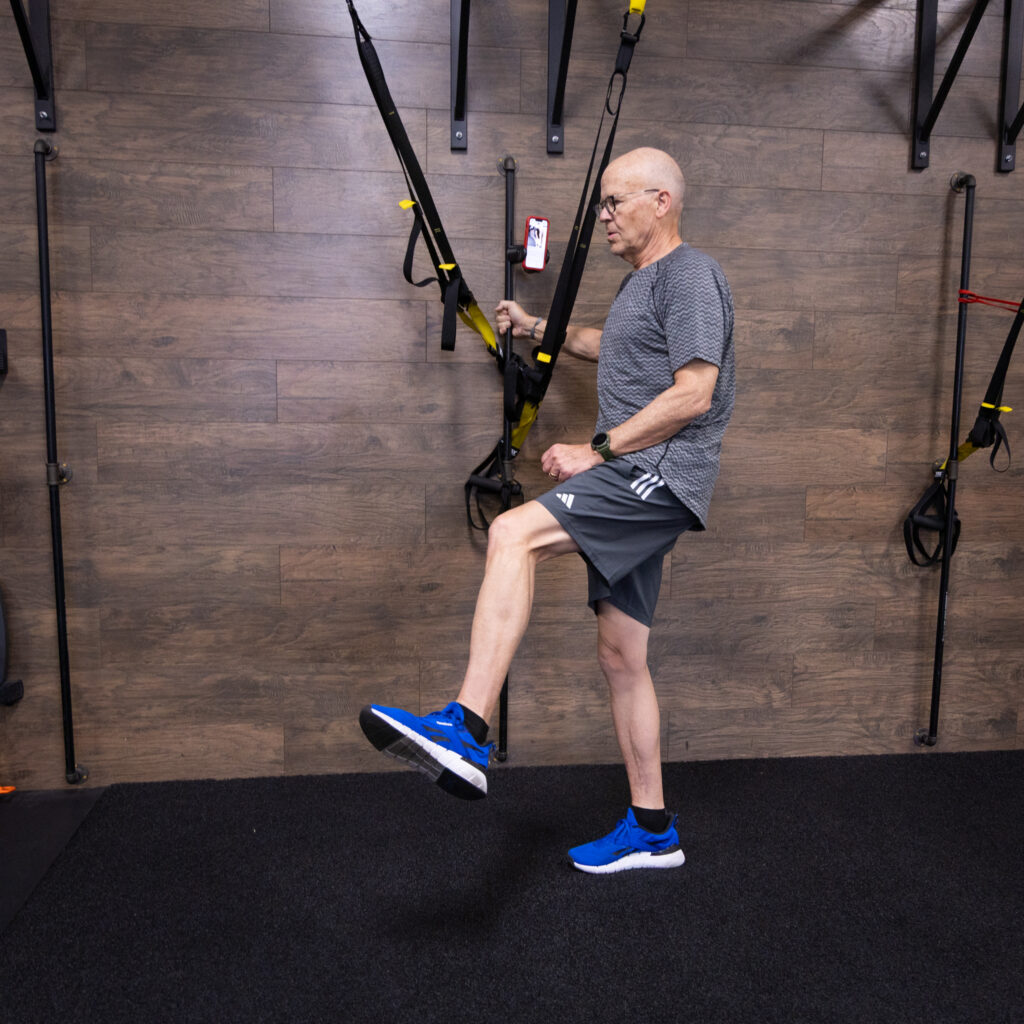
Better balance comes from strength, not from wobbling on an unstable surface. If you’ve ever been told that the way to improve your balance is to stand on a wobbly surface, this article is going to change how you think about that advice.
This is a longer one — and intentionally so. Balance and stability are topics surrounded by a lot of well-meaning but incomplete guidance, and the full picture is worth understanding. Here’s how this article is organized:
- Part 1: What balance actually is and why it declines with age
- Part 2: Why wobble boards and Bosu balls fall short — and what the research says instead
- Part 3: How strength creates stability — and the irradiation principle that makes single-leg training actually work
- Part 4: Why we train power and deceleration at Block Fitness — and why it matters more than most people expect
- Part 5: What this looks like in practice for adults over 40
You can read straight through or jump to the section most relevant to you. Either way, by the end you’ll understand exactly how and why we train balance and stability at Block Fitness — and why our approach produces results that wobble boards don’t.
Part 1: What Balance Actually Is — And Why It Gets Harder After 40
Most people think of balance as a skill. Something you either have or don’t. Something that just… deteriorates as you get older, like eyesight or hairline.
That’s not quite right.
Balance is a system. And like any system, when it stops working well, something specific is breaking down.
Here’s how the system works.
Your body uses three sources of information to know where it is in space and stay upright:
Your eyes. Visual input tells your brain what’s around you and helps orient your body relative to the world.
Your inner ear. The vestibular system detects movement, head position, and changes in direction. It’s the reason you can stay upright in the dark.
Your joints and muscles. This one is the most important for training purposes. Sensors in your muscles, tendons, and joints send constant signals to your brain about where your limbs are, how much load they’re under, and how fast things are changing. This is called proprioception — your body’s internal GPS.
Your brain takes all three inputs, processes them faster than you can think, and sends signals back to your muscles to make the tiny adjustments that keep you upright.
When balance declines with age, it’s usually not because your eyes got worse or your inner ear stopped working. It’s because the muscle side of the equation weakened. The muscles that stabilize your ankles, knees, and hips became less powerful and less responsive. The signals from your joints became slower. And your brain lost some of its ability to act on those signals quickly enough to prevent a stumble.
…
Here’s the key insight: most balance problems are strength problems.
Not flexibility problems. Not wobble board problems. Strength problems.
And the solution to a strength problem is getting stronger.
Part 2: Why Wobble Boards and Bosu Balls Fall Short
Walk into most physical therapy clinics or general fitness classes focused on balance and you’ll see people standing on Bosu balls, wobble boards, and foam pads. The idea seems logical: if your balance is challenged on an unstable surface, your balance should improve.
The problem is that this logic only goes so far — and for adults over 40 who need real, functional stability, it stops well short of where it needs to go.
Here’s why.
The Surface You Train On Is Not the Surface You Live On
When you practice balancing on a wobbly surface, you get better at balancing on a wobbly surface. Your nervous system adapts to that specific challenge.
But the floor is not wobbly. Sidewalks are not wobbly. Stairs are not wobbly. The situations that actually cause falls in adults over 40 — a misstep off a curb, an unexpected change of direction, a patch of uneven ground — are not wobble board situations.
They’re situations that require your muscles to produce and absorb force quickly, on a stable surface, in response to something unexpected.
Training on unstable surfaces doesn’t prepare you for that. It prepares you for unstable surfaces.
Unstable Surface Training Reduces the Load Your Muscles Can Handle
Here’s something most people don’t know: when you stand on a Bosu ball or foam pad, the maximum force your muscles can produce drops significantly. Your body is managing the instability, which limits how hard the muscles can actually work.
Less load means less strength stimulus. Less strength stimulus means less adaptation.
A 2010 study in the Journal of Strength and Conditioning Research confirmed that unstable surface training produces inferior strength gains compared to stable surface training — and that the stability benefits of wobble board training do not transfer reliably to functional, real-world movements.
The Research Points Elsewhere
The most consistent finding in balance and fall prevention research is this: progressive strength training on stable surfaces outperforms unstable surface training for functional balance outcomes in older adults.
A comprehensive review published in the British Journal of Sports Medicine found that resistance training — specifically exercises targeting the lower body and hip musculature — produced greater improvements in balance, gait stability, and fall risk reduction than balance-specific training programs.
Getting stronger is the better balance intervention.
That is the foundation of how we train stability at Block Fitness.
Part 3: How Strength Creates Stability — And the Irradiation Principle
This is the part of the article that changes how most people think about single-leg training and stability work.
The Simple Version First
Think about what actually happens when you lose your balance.
Your ankle wobbles. Your knee buckles slightly inward. Your hip shifts. Something gives way before your brain can catch it.
Now think about what prevents that from happening.
Muscles. Strong, responsive muscles around the ankle, knee, and hip that can detect the wobble and correct it before it becomes a fall. Muscles that produce enough force, fast enough, to keep the joint stable under load.
The stronger those muscles are, the better they are at that job.
This is why strength training is balance training. Not as a metaphor. Literally. When you build stronger glutes, hamstrings, and hip stabilizers through progressive loaded training, you are building the exact physical capacity your balance system relies on.
Now the Part Most Coaches Don’t Talk About: Irradiation
Here’s where it gets interesting.
When you’re doing single-leg training — a single-leg Romanian deadlift, a split squat, a step-up — the goal is to challenge the balance and strength of one leg at a time. That’s valuable. But most people do it with a light weight and a lot of wobbling, hoping the wobbling is the point.
It isn’t.
The wobbling is a sign that the muscles aren’t producing enough tension to stabilize the joint. And there’s a principle in neuroscience that explains exactly how to fix that.
It’s called irradiation.
Here’s the simple version: when one muscle contracts hard, the tension spreads to nearby muscles.
Your nervous system works in networks. When you generate maximum tension in one area, that signal radiates outward to surrounding muscles, recruiting them into the effort. The harder you squeeze, the more muscle your nervous system brings online.
Think about what happens when you grip something really hard. Your forearm tightens. Your bicep tenses slightly. Your shoulder engages. You didn’t consciously do any of that — the tension spread automatically.
The same thing happens in your lower body during single-leg training.
The Practical Example
Imagine you’re doing a single-leg stance. You’re holding a dowel or a TRX handle lightly for support — just fingertip contact.
Now imagine you grip that support as hard as you possibly can.
Feel the difference?
When you grip hard, the tension radiates from your hand up through your forearm, into your shoulder, down through your trunk, and into your hip and leg. Your entire body stiffens slightly. Your base of support becomes more stable. The standing leg has to do less corrective work because the whole system is more organized.
That is irradiation in action.
At Block Fitness, when we coach single-leg exercises, we don’t tell clients to wobble their way to stability. We tell them to hold their support hard — really hard — and feel the tension that creates throughout the body. The grip becomes the anchor for the whole system.
The result is a single-leg exercise that is more stable, allows for better loading, challenges the target muscles more effectively, and builds the coordinated full-body tension that real-world balance actually requires.
Why This Matters More Than a Bosu Ball
A Bosu ball teaches you to manage a wobbly surface with passive, reactive corrections. Irradiation-based single-leg training teaches your nervous system to generate organized, full-body tension on demand.
One of those skills keeps you upright when you step on uneven ground at the park.
The other keeps you balanced on a Bosu ball.
Part 4: Why We Train Power and Deceleration — And Why It Matters
This is the section most people don’t expect in a balance article. But it may be the most important one for adults over 40.
The Balance Problem Nobody Talks About
Here’s the truth about most falls in older adults.
They don’t happen because someone stood still and slowly tipped over. They happen in a fraction of a second — a misstep, a stumble, a sudden change of direction. The person’s foot lands unexpectedly. Their body is moving in one direction and needs to stop or redirect instantly.
The question is not whether their muscles are strong enough to hold a position.
The question is whether their muscles are fast enough and powerful enough to absorb force rapidly and generate a corrective response before the fall completes.
That is a power and deceleration problem. And it requires specific training.
What Power Training Is — In Plain Terms
Power is strength applied quickly.
A muscle that is strong but slow can hold a position. A muscle that is strong and fast can catch you when you stumble.
Think of it this way. Imagine your foot lands on a patch of ice. Your body starts to go. In that moment, the muscles in your hip, knee, and ankle have a fraction of a second to fire hard enough to stop the fall. If they can produce force quickly, they catch you. If they’re slow to respond, you go down.
That speed of force production is trainable. And it is one of the most important physical qualities for adults over 40 to develop and maintain.
At Block Fitness, we include power training for our adult members because the research is clear: explosive strength — the ability to produce force fast — declines faster with age than maximal strength does. A 60-year-old who trains regularly may retain a significant portion of their peak strength. Their rate of force development — how fast they can get there — declines more steeply without specific training.
Training power slows that decline. It keeps the muscles fast. And fast muscles catch you when you stumble.
What Deceleration Training Is — And Why It’s Different
Power training teaches your muscles to accelerate — to produce force quickly in a direction.
Deceleration training teaches your muscles to absorb force — to slow down rapidly, change direction, or stop an unexpected movement before it becomes a fall.
These are related but distinct skills. And deceleration is often the missing piece in standard strength programs.
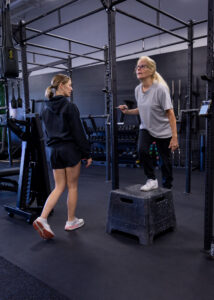
Here’s a simple example. A step-down exercise — standing on a box and slowly lowering one foot toward the ground — trains the quadriceps, glutes, and hip stabilizers to absorb load eccentrically. The muscles are working hard not to produce movement but to control it. To slow it down.
That eccentric, force-absorbing capacity is exactly what fires when your foot lands on uneven ground and your knee needs to stabilize quickly against an unexpected load.
We program deceleration into Block Fitness training through controlled step-downs, lateral deceleration drills, and eccentric-focused lower body exercises. Not because they’re dramatic. Because they build the physical quality that prevents falls in the real world.
The Full Picture
Strength builds the foundation. Power makes the muscles fast. Deceleration teaches them to absorb force. Irradiation teaches the nervous system to organize full-body tension on demand.
Together, these produce an adult over 40 who doesn’t just stand on one leg in a gym. They walk confidently on uneven terrain, catch themselves on a misstep, change direction without bracing for impact, and move through their life with the physical confidence that comes from a body that actually works.
That is the goal. That is what we’re building.
Part 5: What This Looks Like in Practice at Block Fitness
We want to be clear about something.
None of what we’ve described above is extreme. None of it requires a background in athletics or a history of training. The adults we work with at Block Fitness in Oro Valley and the Catalina Foothills include people in their 50s, 60s, 70s, and beyond — many of whom had never done any serious strength training before walking through our doors.
Here’s what a stability-focused training session actually looks like for a Block Fitness member.
Loaded single-leg work with an active grip.
A split squat or step-up holding a rack or TRX handle — gripping hard to generate irradiation and full-body tension. The support isn’t a crutch. It’s a tool that makes the exercise more effective.
Hip hinge patterns.
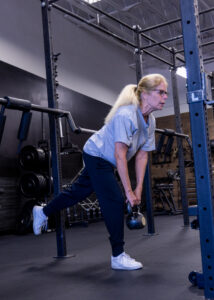
Romanian deadlifts, single-leg deadlifts, and hip bridges that build the posterior chain — the glutes, hamstrings, and spinal stabilizers that do most of the work in real-world balance situations.
Controlled step-downs and lateral deceleration.
Slow, loaded eccentric movements that teach the muscles to absorb force rather than just produce it. These are not glamorous. They are highly effective.
Power work scaled to the individual.
For some members this looks like medicine ball slams or box step-overs performed with intent and speed. For others it’s a faster bodyweight squat or a controlled jump with a soft landing. The principle is the same: train the muscles to produce and absorb force quickly. The specific exercise matches the person.
Progressive loading over time.
The single most important variable. Every exercise gets harder over time — more weight, more reps, better range of motion. The body keeps adapting. The balance keeps improving.
What you will not see is a Block Fitness member standing on a Bosu ball trying to wobble their way to stability. Not because we’re dismissing the concept out of hand. Because we’ve seen what actually works — in the research and in the gym — and it’s this.
The Bottom Line
Balance declines with age primarily because muscles weaken and slow down.
The solution is not a wobbly surface. The solution is progressive strength training that builds powerful, fast, organized muscles — supported by the irradiation principle, power training, and deceleration work that together address the real demands of real-world stability.
If you’ve been worried about your balance, or you’ve been told your fall risk is increasing, or you simply want to move through your life with more confidence and less hesitation — this is the work that changes that. We’ve watched it happen with adults across Tucson for years.
We’d love to show you what it looks like for you specifically.
Schedule a session at our Oro Valley or Catalina Foothills location and let’s build the foundation your balance is built on.
Move Better. Feel Better. Live Stronger.
Quick Take: FAQ
Q: Is it safe to do single-leg exercises if my balance is already poor?
A: Yes — with the right support and coaching. We start with a stable support to grip hard, which uses irradiation to organize the whole body. As strength improves, the dependence on support decreases naturally. Poor balance is the reason to start this training, not a reason to avoid it.
Q: How quickly does balance improve with strength training?
A: Most adults notice meaningful improvements in stability and confidence within six to eight weeks of consistent training. The nervous system adapts quickly once it’s given the right input.
Q: Should I avoid Bosu balls completely?
A: Not necessarily — they have some uses in specific rehabilitation contexts. For adults over 40 whose primary goal is functional balance and fall prevention, they should not be the centerpiece of a training program. Strength training on stable surfaces produces better outcomes.
Q: Do I need to do power training even if I’m just trying to stay safe and mobile?
A: Especially then. The ability to catch yourself during a stumble is a power quality. It declines faster than strength with age and requires specific training to maintain. It’s one of the most practically important things we develop at Block Fitness.
References
- Orr R, et al. “Power training improves balance in healthy older adults.” Journals of Gerontology. 2006.
- Behm DG, Anderson KG. “The role of instability with resistance training.” Journal of Strength and Conditioning Research. 2006.
- Sherrington C, et al. “Effective exercise for the prevention of falls: a systematic review and meta-analysis.” Journal of the American Geriatrics Society. 2008.
- Zech A, et al. “Balance training for neuromuscular control and performance enhancement: a systematic review.” Journal of Athletic Training. 2010.
- Cadore EL, et al. “Multicomponent exercises including muscle power training enhance muscle mass, power output, and functional outcomes in institutionalized frail nonagenarians.” Age. 2014.
- McGill SM. Low Back Disorders: Evidence-Based Prevention and Rehabilitation. 3rd Edition. Human Kinetics.