
Balance training for adults over 40 looks nothing like what most gyms teach. No foam pads. No wobbly discs. No standing on one leg hoping for the best.
If that’s been your experience, it probably felt disconnected from real life—because it was.
Here’s what we know at Block Fitness: you almost never balance like that in the real world.
You balance when you step off a curb, catch yourself on uneven ground, hike a rocky trail, or reach for something while standing on one leg. Balance isn’t about holding still. It’s about regaining control when things aren’t perfect.
Why balance training for adults over 40 requires a different approach
Traditional balance training focuses on standing on unstable surfaces. The idea sounds reasonable, but the research tells a different story.
According to the CDC, falls are the leading cause of injury-related death among adults over 65—and most of those falls happen during everyday movement, not while standing still on foam. What protects people isn’t the ability to wobble in place. It’s strength, coordination, and the ability to decelerate.
Daily life asks you to:
- move into imbalance and recover
- accept full load on one leg
- shift weight smoothly while moving
- react quickly instead of freezing
That’s why many people can pass a balance test in the gym but still feel unsure on stairs, trails, or uneven sidewalks. The missing piece isn’t more wobbling. It’s functional strength trained through real movement patterns.
What balance actually means after 40
Balance is your ability to control your center of mass over a changing base of support while moving through space. That’s it. And it’s influenced by far more than just your inner ear.
Effective balance training for adults over 40 addresses:
- Leg strength — your foundation for every step
- Hip stability — controls lateral movement and single-leg loading
- Foot and ankle control — your first point of contact with the ground
- Core coordination — keeps your torso stable as your limbs move
- Reaction speed and body awareness — your nervous system’s ability to adapt
Research from the National Institute on Aging confirms that strength-based exercise is one of the most effective ways to improve balance and reduce fall risk in adults over 40. You don’t fix poor balance by standing still. You fix it by training movement under control.
How balance problems show up in people over 40
At Block Fitness, balance problems rarely look dramatic. They show up quietly as:
- hesitating before stepping off curbs or stairs
- feeling wobbly on uneven ground or gravel
- avoiding hiking trails or outdoor activities
- needing to “reset” before shifting weight
- gripping the floor with your toes in a constant state of tension
People often say: “I’m not unbalanced—I’m just cautious.”
That caution is your body sending a signal. It doesn’t fully trust itself yet. And the good news? That trust is trainable. Strength training over 40 is one of the most powerful tools for rebuilding that confidence.
5 methods we use for balance training at Block Fitness
In our semi-private training sessions across Tucson, Oro Valley, and Catalina Foothills, we train balance inside real movement patterns. Not isolated. Not gimmicky. Here’s how.
1. Single-leg strength (the foundation of balance training for adults over 40)
Balance starts with one-leg strength. If one leg can’t accept load confidently, your nervous system stays in protective mode—cautious, hesitant, restricted.
We build single-leg strength with:
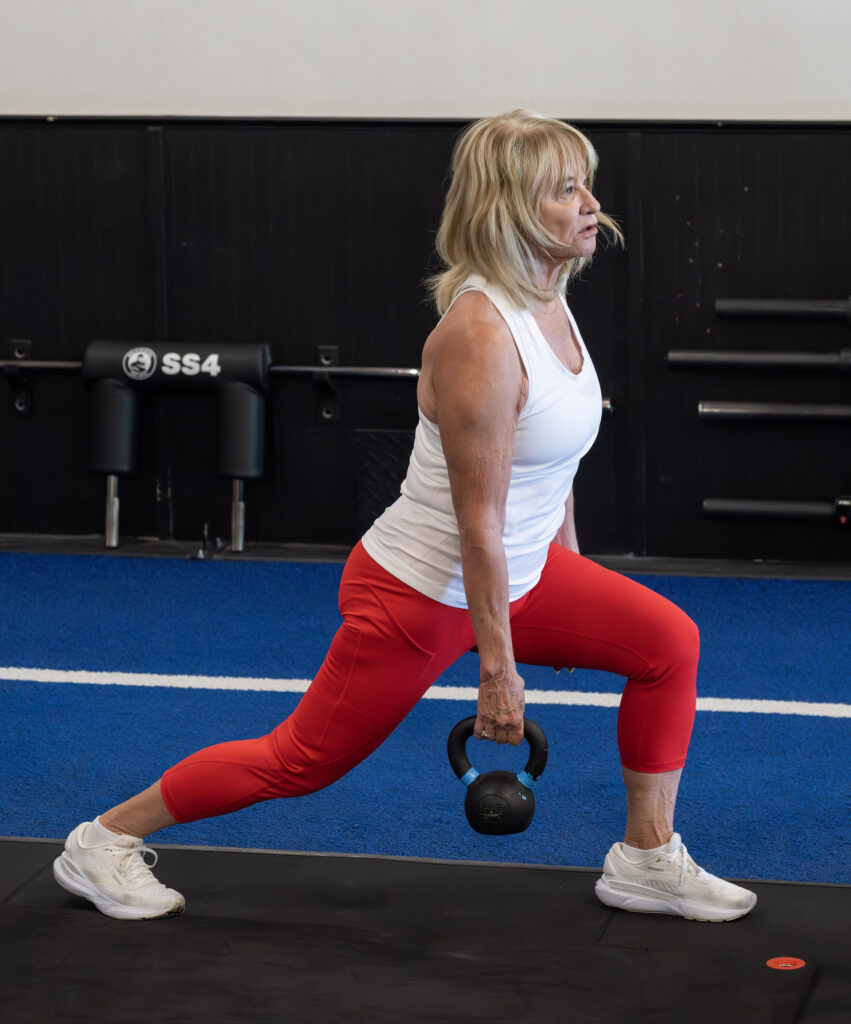
- split squats and rear-foot elevated variations
- step-ups and controlled step-downs
- slow eccentric lunges with a pause at the bottom
- single-leg Romanian deadlifts for hip and hamstring stability
Not fast. Not fancy. Just controlled movement that teaches each leg to hold you up. When leg strength improves, balance often improves without being directly trained—because the body finally has the capacity to move with confidence.
2. Weight shifts and transitions
Life isn’t static, and neither is good balance. The ability to shift weight smoothly—from two feet to one, from standing to stepping, from still to moving—is where real balance lives.
We train:
- controlled stepping patterns in multiple directions
- smooth transitions from two-foot to single-leg stance
- direction changes at varying speeds
This teaches your nervous system: “I know where I am—and I can move from here.” That’s functional balance training for adults over 40 in practice.
3. Deceleration (the most overlooked balance skill)
Most falls happen not because people can’t stand still, but because they can’t slow themselves down. Deceleration—the ability to absorb force and stop controlled movement—is one of the most undertrained skills in fitness.
We train deceleration with:
- slow, controlled step-downs with a pause at the bottom
- eccentric-focused landings and direction changes
- deliberate pauses at the hardest part of each rep
Training deceleration builds confidence fast—especially around knees, hips, and ankles—and it transfers directly to real life: catching yourself on a slippery floor, stopping short on a downhill trail, or landing a step you didn’t see coming.
4. Foot and ankle strength that actually transfers
Balance doesn’t start at the hip or knee. It starts at your foot. The foot is your first point of contact with the ground, and if it can’t sense and adapt, nothing above it works as well as it should.
We train feet and ankles through:
- barefoot or minimal-shoe work when appropriate
- controlled ankle range under load
- foot pressure awareness during all lower-body movements
Not endless calf raises. Functional strength that transfers. When the foot can read the ground and respond, balance improves everywhere else.
5. Carries and asymmetrical loading
Carrying weight on one side is one of the most effective—and underused—forms of balance training for adults over 40. It forces immediate core engagement, postural adjustments, and natural balance corrections.
We use:
- single-arm carries (farmer’s carry, suitcase carry)
- offset loads during walking variations
- asymmetrical presses and rows that challenge lateral stability
This looks a lot like real life: carrying groceries, a bag, a child, or any uneven load. Carries train balance without anyone thinking about balance—and that’s the sweet spot.
What balance training is really about for adults over 40
Effective balance training isn’t about perfection. It’s about recovery. The goal isn’t to never lose your balance—it’s to regain control quickly when you do.
Can you:
- lose your footing briefly and recover without panic?
- step confidently instead of hesitating?
- trust your leg to hold you up when it counts?
That’s what our members build at Block Fitness—not just better gym performance, but the ability to hike more, move faster, and stop avoiding situations that used to feel risky.
Quick reference: Real balance vs. gym balance
Balance isn’t:
- standing still on unstable objects
- chasing wobble for its own sake
- holding your breath and hoping for the best
Balance is:
- strength on one leg under real conditions
- smooth, confident weight transitions
- controlled deceleration and recovery
- confidence under load, in motion, in real life
Train movement well. Balance follows.
FAQ: Balance training for adults over 40
Do I need balance training if I’m not falling?
Yes—hesitation and avoidance typically come before falls. Addressing balance early protects you long-term and keeps you active in the activities you love.
Is balance mostly neurological or strength-based?
Both. Strength gives your nervous system the confidence to allow full movement. When your legs are strong enough to trust, your brain stops holding back.
How often should balance be trained?
At Block Fitness, balance is built into nearly every session through lunges, step work, carries, and transitions—