
Nutrition for fat loss is one of the most misunderstood topics in fitness, and this is the nutrition article we’ve wanted to write for a long time.
Not a quick tip list. Not a meal plan. Not a set of rules that sounds good and falls apart by Wednesday. A real, complete explanation of how nutrition works for adults who want to change their body composition — lose fat, build muscle, and understand why the two goals require different strategies and different timeframes.
This article is longer than most of what we publish. It needs to be. Because the reason most adults over 40 aren’t getting the results they’re working for isn’t effort — it’s missing information. And partial information produces partial results, or worse, the wrong results entirely.
Here’s how this article is organized:
- Part 1: The foundation — why calories are the starting point for everything
- Part 2: Why protein is the most important variable for adults who train
- Part 3: Fat loss done right — what it actually requires and what it doesn’t
- Part 4: Building muscle — why you can’t do it in a deficit and what a real surplus looks like
- Part 5: The nutrition pyramid — how to prioritize when everything feels important
- Part 6: How long this actually takes — the honest timeline most people never get
- Part 7: The most common mistakes and how to fix them
Read straight through or jump to the section most relevant to where you are right now. Either way, by the end you’ll have a clearer picture of nutrition than most people ever develop — and a framework you can actually apply.
Part 1: The Foundation — Calories Are the Non-Negotiable Starting Point
Before anything else, before protein targets and meal timing and supplement stacks, there is one variable that determines whether your body loses fat, gains muscle, or stays exactly where it is.
Total calories.
The math is not flexible. It does not negotiate with your intentions. It does not care how clean your food is or how hard you trained. Energy in versus energy out over time is the foundation of every body composition outcome — and if this piece isn’t right, nothing else compensates for it.
Here’s the simple version.
Your body burns a certain number of calories every day — through basic metabolic function, digestion, daily movement, and exercise. This is your total daily energy expenditure.
If you consistently eat more calories than you burn, your body has a surplus. It stores that surplus — as fat, or as muscle if the training and protein conditions are right.
If you consistently eat fewer calories than you burn, your body has a deficit. It draws on stored energy to make up the difference — ideally fat, though muscle is also at risk without adequate protein and training stimulus.
If you consistently eat roughly what you burn, your weight stays stable.
The direction of your body composition is determined by which side of that equation you’re consistently on over weeks and months. Not days. Weeks and months.
…
Most people who aren’t losing fat are eating more than they think. Most people who aren’t building muscle are eating less than they think. This is not a character judgment. It is one of the most consistently replicated findings in nutrition research. Humans are poor estimators of their own calorie intake — studies show we underestimate consumption by 20 to 50 percent on average, across all demographics and education levels.
This is why tracking — even briefly, even imperfectly — is one of the most valuable things an adult can do to understand their starting point. Not forever. Not obsessively. For long enough to get an honest picture of what’s actually going into the body.
The math does not negotiate. But once you know the numbers, you can work with them.
Part 2: Protein — The Most Important Variable for Adults Who Train
Once calories are established, protein is the variable that determines what happens to your muscle mass regardless of which direction you’re going.
Losing fat: adequate protein preserves the muscle you’ve built while the deficit drives fat loss.
Building muscle: adequate protein provides the raw material for the growth the training stimulus is calling for.
Maintaining: adequate protein keeps the metabolic engine running and prevents the gradual muscle loss that accelerates after 50.
In every scenario, protein is the non-negotiable second layer.
Why the Standard Recommendation Falls Short
The Recommended Dietary Allowance for protein is 0.8 grams per kilogram of bodyweight per day. You will see this number cited constantly — on nutrition labels, in general health guidelines, in advice from well-meaning practitioners.
For adults over 40 who train, it is almost certainly not enough.
The RDA represents the minimum intake to prevent deficiency in a sedentary population. It was not designed to optimize muscle retention in a 55-year-old doing three strength sessions per week. Those are different problems with different answers.
The current research consensus for active adults — and particularly for adults over 50 dealing with anabolic resistance, the age-related decline in the muscle-building response to protein — points to a significantly higher target: 0.7 to 1.0 grams per pound of bodyweight per day.
For a 160-pound adult, that is 112 to 160 grams of protein daily. Most people, when they honestly track their intake, find they’re hitting roughly half that.
Distribution Matters as Much as Total
How you spread protein across the day matters — especially after 50.
Because of anabolic resistance, older adults need a larger protein dose per meal to trigger a meaningful muscle-building response. Research suggests approximately 30 to 40 grams of protein per meal, across three to four meals, as the most effective distribution for adults over 50.
A large protein hit at dinner does not fully compensate for low-protein breakfast and lunch. The signal needs to be triggered multiple times across the day.
Practical targets per meal:
- Breakfast: 30 to 40 grams — eggs, Greek yogurt, cottage cheese, protein shake
- Lunch: 30 to 40 grams — chicken, fish, lean beef, legumes with a complete protein source
- Dinner: 30 to 40 grams — another substantial animal or plant protein source
- Optional snack: 15 to 25 grams if gaps exist
The Best Protein Sources
Not all protein is created equal. The key variable is leucine content — leucine is the amino acid that acts as the primary trigger for muscle protein synthesis, and it’s concentrated most heavily in animal-based proteins.
Highest quality sources: eggs and egg whites, chicken breast and thighs, lean beef and bison, salmon and other fatty fish, shrimp and white fish, Greek yogurt, cottage cheese, whey protein.
Plant-based sources — soy, lentils, beans, quinoa, edamame — contribute meaningfully but typically require larger serving sizes to deliver equivalent leucine. If you’re predominantly plant-based, the protein target likely needs to move toward the higher end of the range, and combining protein sources across the day becomes more important.
Part 3: Nutrition for Fat Loss Done Right — What It Actually Requires
With the foundation established, here’s what genuine fat loss — losing body fat while preserving muscle — actually requires. Not weight loss. Fat loss. These are not the same thing, and the distinction matters enormously.
The Deficit: Moderate, Not Aggressive
A caloric deficit is required to lose fat. There is no way around this. But the size of the deficit determines what you lose alongside the fat.
An aggressive deficit — cutting 800 to 1,000 calories or more per day — accelerates fat loss in the short term. It also accelerates muscle loss, suppresses hormones that support recovery and adaptation, reduces training performance, and triggers the metabolic adaptation that makes weight regain faster and more complete when the diet ends.
For adults over 40, who are already fighting age-related muscle loss and anabolic resistance, aggressive deficits are a particularly poor trade.
The target that produces the best fat loss outcomes with the least muscle loss: a moderate deficit of 300 to 500 calories per day, maintained consistently over weeks and months.
This produces fat loss of roughly 0.5 to 1 pound per week — which sounds slow compared to what aggressive diets promise. But it’s fat, not muscle. The body composition at the end looks and functions differently than the same weight lost through aggressive restriction.
Protein Protects Muscle During a Deficit
This is worth repeating because it is the most important practical point in fat loss nutrition.
During a caloric deficit, the body is looking for energy. It will take it from fat stores — but it will also take it from muscle tissue unless given a reason not to. That reason is adequate protein and resistance training.
High protein intake during a deficit signals the body to preserve muscle. Resistance training signals the body to preserve muscle. Together they create the conditions where the deficit draws primarily from fat rather than from the lean tissue you’ve worked to build.
This is why the adults at Block Fitness who lose fat successfully look different at a lower weight than people who lose the same amount of weight through diet alone. They preserved the muscle. The body composition underneath the fat was protected and developed while the fat was being reduced.
What Fat Loss Actually Feels Like
Sustainable fat loss is not dramatic week to week. It requires patience and a longer lens than most people apply.
A well-executed fat loss phase looks like this: consistent moderate deficit, high protein, three strength sessions per week, adequate sleep, and honest tracking. Over eight to twelve weeks, the scale moves down one to two pounds per week on average — some weeks more, some weeks less or nothing at all due to water retention and normal fluctuation. Over six months, the cumulative change becomes significant and visible.
The scale is not the only measurement. How clothes fit, strength levels in training, body measurements, and energy levels are all relevant data points. Some weeks the scale will be frustrating and every other measurement will be positive. Stay focused on the direction over time, not the number on any given morning.
Part 4: Building Muscle — Why You Can’t Do It in a Deficit
This is the section that trips most people up.
The goal most Block Fitness members describe when they walk in — lose fat and tone up, or lose weight and get stronger — is actually two goals. And those two goals require conditions that work against each other.
Fat loss requires a caloric deficit.
Muscle building requires a caloric surplus.
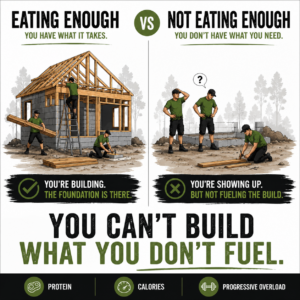
You cannot fully optimize both simultaneously. The body cannot maximally build new tissue while running on less fuel than it needs. Understanding this changes how to approach the goal.
Body Recomposition: The Middle Path
For adults who are newer to training, returning after a long break, or carrying meaningful excess body fat, a middle path exists: body recomposition. Eating near maintenance calories — neither a significant surplus nor a significant deficit — while training progressively and hitting protein targets.
In this state, the body can make modest improvements in both directions simultaneously. Fat decreases gradually. Muscle is preserved and slowly built. The scale may not move much. The body composition underneath is shifting.
Recomposition is slower than pursuing either goal exclusively. But for adults over 40 who don’t want to go through dedicated bulk and cut phases, it is a legitimate and sustainable strategy — especially for the first year of consistent training.
The Dedicated Muscle-Building Phase: What a Real Surplus Looks Like
For adults who have been training consistently for a year or more and want to prioritize muscle building, a deliberate caloric surplus is required.
The operative word is deliberate. A small, controlled surplus — not an open-ended eating strategy.
The research on muscle building consistently points to a modest surplus as the most effective approach for minimizing fat gain while maximizing muscle growth. A surplus of 200 to 300 calories per day above maintenance — roughly one additional small meal or significant snack — provides the energy and nutrient availability the body needs to build tissue without excessive fat accumulation alongside it.
At 250 calories per day over 90 days, that’s 22,500 surplus calories — enough to support meaningful muscle growth without undoing the body composition work done in previous phases.
What this looks like practically: if your maintenance caloric intake is 2,200 calories per day, a muscle-building phase targets 2,400 to 2,500 calories — with protein still hitting 0.7 to 1.0 grams per pound of bodyweight. The additional calories come primarily from carbohydrates and fats that fuel training performance and recovery.
Why Training Hard Matters More During a Surplus
A surplus without training produces fat gain. Full stop. This is where nutrition for fat loss and nutrition for muscle gain diverge.
The surplus creates the conditions for muscle building. The training provides the signal that tells the body where to direct that energy — into muscle tissue rather than fat storage. Progressive overload during a surplus is the mechanism that converts the additional caloric intake into muscle rather than simply adding body fat.
This is why nutrition and training cannot be separated. The best nutrition strategy in the world produces poor results without the right training. The best training program produces poor results without the right nutrition. At Block Fitness, we look at both — because both matter.
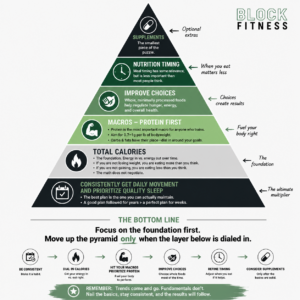
Part 5: The Nutrition Pyramid — How to Prioritize When Everything Feels Important
The nutrition conversation can become overwhelming quickly. Macros, timing, supplements, food quality, hydration, sleep — there are dozens of variables that all have some legitimate relevance.
The key is understanding which variables matter most and addressing them in the right order. Optimizing meal timing while ignoring total calories is like putting premium gas in a car with a flat tire. The hierarchy matters.
Here’s how we think about it at Block Fitness, from the base up:
Layer 1 — Consistent daily movement and quality sleep. This is the foundation beneath the nutrition pyramid. A good nutrition plan followed for years outperforms a perfect plan followed for weeks. Sleep is where recovery happens, where hormones regulate, and where the adaptations from training are consolidated. Without adequate sleep — seven to nine hours consistently — every layer above is compromised.
Layer 2 — Total calories. Energy in versus energy out. This determines direction. If you’re not losing fat, the calories are higher than they need to be. If you’re not building muscle, they may be lower than they need to be. Get this layer right before worrying about anything above it.
Layer 3 — Macros, protein first. Once calories are established, protein is the priority. 0.7 to 1.0 grams per pound of bodyweight, distributed across three to four meals. Carbohydrates and fats fill in the remaining calories in a ratio that fits preferences and supports training performance.
Layer 4 — Food quality. Whole, minimally processed foods regulate hunger better, provide more micronutrients per calorie, and support overall health in ways that processed foods don’t. This layer matters — but it sits above calories and protein in priority. Eating clean food in the wrong caloric range still produces poor body composition outcomes.
Layer 5 — Nutrition timing. When you eat has some relevance — protein within a few hours of training supports muscle protein synthesis, and distributing protein across the day matters for anabolic response. But timing is a refinement, not a foundation. Get layers one through four right first.
Layer 6 — Supplements. Whey protein to hit protein targets, creatine for strength and muscle support, vitamin D and omega-3s for general health. These are genuinely useful — as the final layer of optimization after everything below is solid. Supplements do not compensate for inadequate calories, low protein, poor sleep, or inconsistent training.
The bottom line: focus on the foundation first. Move up the pyramid only when the layer below is dialed in.
Part 6: How Long This Actually Takes — The Honest Timeline
This is the section most people need most and receive least often.
The fitness industry runs on short timelines. Eight-week transformations. Twelve-week challenges. Before and after photos that suggest dramatic change happens in weeks. These timelines are not representative of how real, lasting body composition change works for adults over 40.
Here is the honest version.
Fat Loss Timeline
A well-executed fat loss phase — moderate deficit, high protein, three strength sessions per week — produces meaningful results over the following timeline:
Weeks 1 to 2: Initial water weight and glycogen reduction. The scale may drop faster than expected early on. This is not fat. It is water associated with reduced carbohydrate intake and lower sodium. Do not mistake this for fat loss rate.
Weeks 3 to 8: Genuine fat loss begins accumulating. At 0.5 to 1 pound per week, this is 2 to 6 pounds of actual fat over this period. Clothes begin fitting differently. Energy stabilizes as the body adapts to the new intake.
Weeks 8 to 16: The cumulative change becomes visible and measurable. Strength has been maintained or improved. Body composition is meaningfully different. Six to twelve pounds of fat lost with muscle preserved is a significant physical change — one that looks and functions differently than the same weight lost through crash dieting.
Six months of consistent execution: This is where the results that genuinely change how someone looks and feels become undeniable. Not dramatic in any single week. Significant in aggregate.
Muscle Building Timeline
Muscle building is slower than fat loss, particularly for adults over 40.
Weeks 1 to 4: Neurological adaptation. Strength increases rapidly as the nervous system becomes more efficient at recruiting muscle. The muscle itself has not changed significantly yet.
Weeks 4 to 12: Muscle tissue begins to change. Strength continues climbing. Body weight increases slightly if in a surplus. Arms, shoulders, and legs begin to feel and look different.
Three to six months: Visible muscle development becomes noticeable to others. Strength is meaningfully higher than baseline. Functional capacity — how the body performs in daily life — has changed.
One year of consistent training and appropriate nutrition: This is the timeline at which adults over 40 who have committed to the process look and perform at a level that genuinely surprises them. Not because anything magical happened. Because compound adaptation over twelve months produces results that no single month can reveal.
The Honest Summary
Fat loss of significance: three to six months of consistent execution.
Muscle building of significance: six to twelve months of consistent execution.
Both goals pursued through body recomposition: twelve to eighteen months to produce the combined result that either goal alone would take six to twelve months to achieve separately.
These timelines feel long to people accustomed to quick-fix marketing. They are, in fact, the timelines that produce results that last. Results built over months are built on real structural change — muscle gained, fat lost, habits established. They do not reverse when the program ends because the program became the lifestyle.
Part 7: The Most Common Mistakes — And How to Fix Them
After years of coaching adults at Block Fitness, here are the mistakes we see most consistently — and what to do about each one.
Mistake 1: Eating Too Little and Training Hard
The combination of significant caloric restriction and hard training is one of the most common patterns we see in new members — and one of the least effective for body composition.
The body under aggressive caloric restriction prioritizes survival. It reduces metabolic rate. It breaks down muscle for fuel. It resists fat loss as a protective mechanism. Hard training adds stress to an already stressed system. The result is fatigue, poor recovery, stalled results, and often injury.
The fix: establish a moderate deficit, not an aggressive one. Fuel the training. Protect the protein. Trust the slower timeline.
Mistake 2: Not Tracking — Even Briefly
Most adults significantly underestimate their caloric intake and overestimate their protein consumption. This is not a flaw — it is a well-documented human tendency. Without tracking, the gap between what people think they’re eating and what they’re actually eating is often large enough to explain poor results entirely.
The fix: track honestly for two to four weeks using a reliable app. Not forever. Long enough to establish an accurate baseline. The data usually reveals the answer immediately.
Mistake 3: Inconsistent Protein
Hitting protein targets two days out of seven is not adequate protein intake. The muscle-building and muscle-preserving signals from protein require consistent, daily delivery to be effective.
The fix: identify two to three high-protein meals that are reliable, repeatable, and easy to prepare. Build the protein foundation first at every meal, then fill in carbohydrates and fats around it.
Mistake 4: Expecting Results in Weeks That Take Months
Abandoning a nutrition strategy after four weeks because the results aren’t visible is one of the most common reasons adults over 40 never reach their body composition goals. Four weeks is not enough time to evaluate a nutrition strategy. Eight to twelve weeks of consistent execution is the minimum meaningful evaluation window.
The fix: commit to a twelve-week block of consistent execution before evaluating. Take measurements at the start. Track strength in training. Give the strategy enough time to actually work before drawing conclusions.
Mistake 5: Optimizing the Wrong Layer
Spending energy on meal timing, supplement selection, and food quality while ignoring a significant caloric miscalculation or a protein intake that’s half the target is a very common mistake — and one the nutrition pyramid above addresses directly.
The fix: audit the foundation first. Calories, then protein, then food quality, then timing. In that order. Every time.
The Bottom Line
Nutrition for body composition is not complicated. But it does require understanding the hierarchy — what matters most, in what order, over what timeframe.
Calories determine direction. Protein determines what you keep and what you build. A moderate deficit drives fat loss without sacrificing muscle. A modest surplus drives muscle building when training provides the signal. Food quality, timing, and supplements refine the outcome after the foundation is solid.
And time — honest, realistic, patient time — is the variable that determines whether any of it actually works.
At Block Fitness, we’ve watched adults across Oro Valley and the Catalina Foothills apply these principles consistently and arrive at results that surprised them. Not because the principles are secret. Because they gave them enough time to work, and they had a coaching environment that held them accountable to the process.
If you want to understand what this looks like for your specific goals, history, and starting point — that’s exactly the conversation we start with.
Schedule a session at our Oro Valley or Catalina Foothills location and let’s build the nutrition foundation your training deserves.
Move Better. Feel Better. Live Stronger.
Quick Take: FAQ
Q: Should I lose fat first or build muscle first?
A: For most adults over 40 with moderate body fat to lose, starting with a fat loss phase makes sense — reduced body fat improves insulin sensitivity and the anabolic response to training, which makes a subsequent muscle-building phase more effective. If you’re relatively lean already, body recomposition or a modest surplus may be the right starting point. A coach can help you assess which approach fits your current situation.
Q: Do I need to count calories forever?
A: No. Most people track consistently for a period, develop an accurate intuitive sense of their intake, and then track periodically to recalibrate. The goal is awareness, not permanent tracking. A few weeks of honest tracking every six months is often enough to stay on course.
Q: What about carbohydrates — should I be eating low-carb?
A: Carbohydrates are not the enemy. They are the body’s preferred fuel source for high-intensity training and they support recovery, performance, and training adaptation. Low-carb approaches can produce fat loss — because they often reduce total calories and improve protein proportion — but they are not uniquely effective compared to any other approach that produces a moderate deficit with adequate protein. Eat the carbohydrate level that allows you to train well and feel good while hitting your caloric and protein targets.
Q: Is intermittent fasting effective for fat loss?
A: Intermittent fasting is a tool for managing caloric intake — not a mechanism with unique fat loss properties. If compressing your eating window helps you maintain a moderate deficit and hit your protein targets, it’s a useful approach. If it makes protein distribution difficult or compromises training performance, it may not be the right tool for you.
Q: What supplements are actually worth taking?
A: After the foundational layers are solid, three supplements have consistent research support for adults who train: whey protein (for hitting protein targets conveniently), creatine monohydrate (for strength, power, and muscle building support), and vitamin D (commonly deficient and relevant to muscle function and immune health). Everything else is optional and context-dependent.
References
- Morton RW, et al. “A systematic review, meta-analysis and meta-regression of the effect of protein supplementation on resistance training-induced gains in muscle mass and strength.” British Journal of Sports Medicine. 2018.
- Stokes T, et al. “Recent perspectives regarding the role of dietary protein for the promotion of muscle hypertrophy with resistance exercise training.” Nutrients. 2018.
- Bauer J, et al. “Evidence-based recommendations for optimal dietary protein intake in older people.” Journal of the Academy of Nutrition and Dietetics. 2013.
- Schoenfeld BJ, Aragon AA. “How much protein can the body use in a single meal for muscle building?” Journal of the International Society of Sports Nutrition. 2018.
- Hall KD, et al. “Ultra-processed diets cause excess calorie intake and weight gain.” Cell Metabolism. 2019.
- Pontzer H, et al. “Constrained total energy expenditure and metabolic adaptation to physical activity in adult humans.” Current Biology. 2016.
- Antonio J, et al. “A high protein diet has no harmful effects: a one-year crossover study in resistance-trained males.” Journal of Nutrition and Metabolism. 2016.
- Kreider RB, et al. “International Society of Sports Nutrition position stand: safety and efficacy of creatine supplementation in exercise, sport, and medicine.” Journal of the International Society of Sports Nutrition. 2017.