
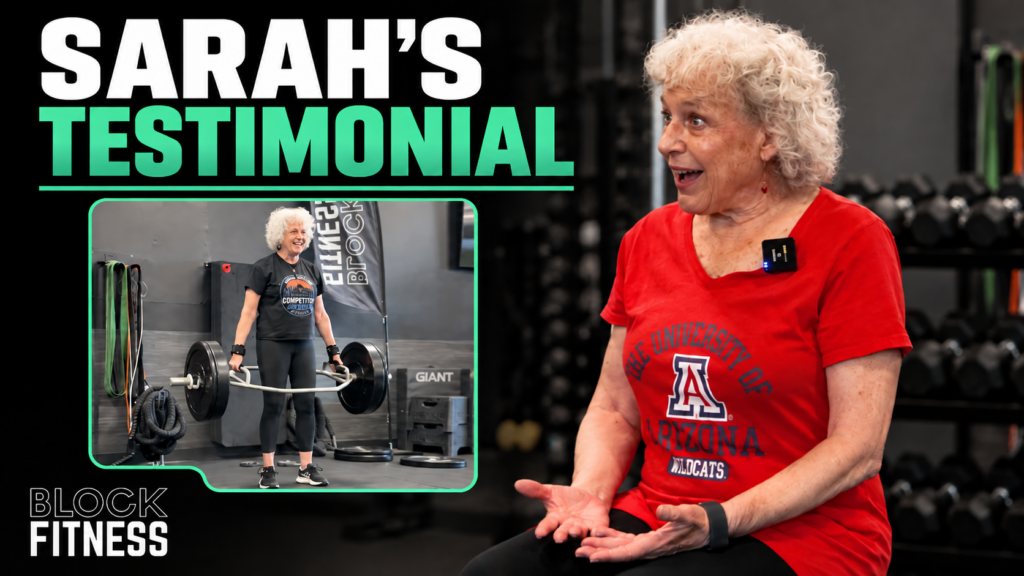
Sarah was diagnosed with osteoporosis, and strength training changed the outcome her doctor expected.
Osteopenia in some areas. Osteoporosis in others. Her doctor presented the standard path forward.
She did not want to take the medication.
“I really didn’t wanna take the medicine. So I decided to sign up and see if it would work.”
She came to Block Fitness Catalina Foothills in January 2025 and committed to finding out.
Her next bone scan gave her the answer.
“After I had a bone scan, the osteoporosis in my upper back cleared.”
Not reduced. Cleared.
What the Strength Training Research Has Been Saying All Along
Sarah’s result is remarkable. It is also not a surprise to anyone who follows the research on bone density and resistance training.
Progressive strength training is one of the most effective non-pharmacological interventions for osteoporosis available to older adults. Bone tissue responds to mechanical load — it remodels and strengthens in response to the demand placed on it. The same principle that builds muscle builds bone.
What Sarah experienced is what the science predicts when training is done consistently, progressively, and correctly.
She chose to find out if it would work. It worked.
She Couldn’t Lie on the Floor
Sarah’s starting point is worth understanding clearly.
She came in anxious. She had a history of middle back problems. She had injured herself at other gyms. The idea of walking into a training environment and trusting it with a back that had already been hurt — and a spine dealing with osteoporosis — required real courage.
She also could not lie on the floor when she started.
“I came in not being able to lie on the floor. So what? And now that’s not true anymore. I have a really strong back now.”
A year and a half. Zero injuries. A back that went from unable to lie flat to genuinely strong. That is what consistent strength training can do for a body other gyms had already hurt.
“I’ve been here for a year and a half and I haven’t. There has been absolutely no injury.”
That safety record — in a person with her history, at other gyms that hurt her — is a direct result of coaching that understands how to build a person up rather than just put them through a workout.
150 Pounds and a Horse
Sarah’s personal best is 150 pounds, built through consistent strength training.
“I never would’ve thought that I could do that.”
She also rides horses now in a way she never used to be able to. She hikes without the fatigue that used to stop her. The strength she has built in the gym has transferred into every physical demand her life makes on her body.
“I can feel it.”
That is the whole point. Not a number on a bar. Not a before and after photo. The felt experience of a body that works — that carries you through horses and hikes and everything else — in a way it did not before.
Start Anywhere
Sarah’s message is as direct and generous as her story.
“Find a supportive environment and start anywhere. It doesn’t matter.”
She started unable to lie on the floor. She started with a back history and an osteoporosis diagnosis and anxiety about trusting a gym again after being hurt before.
She started anyway.
“All right — start anywhere.”
Her bone scan cleared. Her back is strong. Her personal best is 150 pounds. She rides horses.
Start anywhere.
If Sarah’s story resonates — if you’ve been given a diagnosis and want to know whether training can change it — we’d love to have that conversation at Block Fitness Catalina Foothills.
Schedule your first session here and let’s find out what’s possible.
Move Better. Feel Better. Live Stronger.
Quick Take: FAQ
Q: Can strength training actually improve bone density? A: The research is consistent and the evidence is strong — progressive resistance training is one of the most effective interventions available for improving bone mineral density in adults with osteoporosis and osteopenia. Sarah’s bone scan result is consistent with what the science predicts.
Q: Is it safe to train with osteoporosis or a back history? A: With individualized programming and qualified coaching — yes. Strength training is safe even with a diagnosis like Sarah’s. She came in with both and has had zero injuries in a year and a half. The key is a program built around your specific situation, not a generic workout applied regardless of history.
Q: What if I’ve injured myself at a gym before? A: Sarah had too. The difference is the coaching environment. A program built for you, coached by someone who watches your form and knows your history, produces a fundamentally different safety profile than self-directed training at a big box gym.