
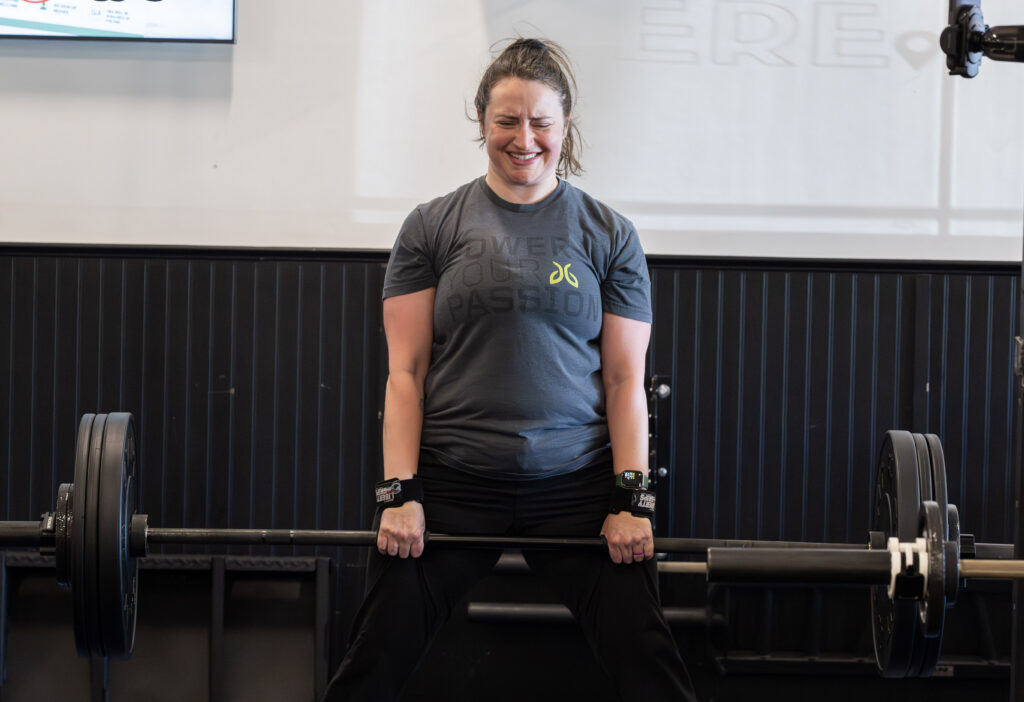
Mention the word deadlift to most adults over 40 and you’ll get one of two reactions….
Either they light up — because they’ve done it, they know what it does, and they’ve felt the difference it makes in how their body functions.
Or they get uncomfortable. “Isn’t that the one that hurts people’s backs?” “My doctor told me to avoid it.” “I saw someone get injured doing that.”
That second group is who this post is for.
Because the deadlift has a reputation problem. And the reputation is wrong.
The Fear Is Understandable. It’s Also Costing People.
Here’s where the fear comes from.
Someone sees a video of a powerlifter grinding through a 600-pound pull with a rounded spine and veins in their forehead. Or they know someone who “threw out their back deadlifting.” Or a well-meaning professional told them to avoid heavy lifting as a general precaution.
None of that is unreasonable in isolation.
The problem is the conclusion people draw from it: that the deadlift itself is dangerous. That the movement pattern is inherently risky. That adults over 40 — especially those with any history of back pain — should stay away from it entirely.
That conclusion is not supported by the evidence. And acting on it comes at a real cost.
What the Deadlift Actually Is
Strip away the gym mythology and the deadlift is one of the most fundamental human movement patterns that exists.
It is, at its core, a hip hinge. You load your hips, maintain a neutral spine, brace your core, and lift something off the ground. That’s it. Your body was designed to do this. You do a version of it every time you pick up a bag of groceries, lift a grandchild, load the dishwasher, or get something out of the back of your car.
The deadlift doesn’t create a new movement. It trains the one you’re already doing — and teaches you to do it with control, tension, and intention rather than casually and carelessly.
The version that hurts people is not a trained, coached, progressively loaded deadlift. It’s a poorly executed hip hinge performed under too much load, without adequate preparation, by someone who has never been taught how to do it correctly.
The movement isn’t the problem. The execution is.
What the Research Actually Says
The narrative that heavy lifting damages the spine doesn’t hold up under scrutiny.
A 2015 review published in the British Journal of Sports Medicine examined spinal loading during resistance training and found that properly performed strength training, including hip hinge patterns, does not produce pathological spinal loading in healthy trained individuals — and in many cases improves the structural capacity of spinal tissue over time.
More relevant to the adults we train at Block Fitness: research on older adults consistently shows that progressive resistance training reduces low back pain, improves functional movement capacity, and builds the posterior chain strength that protects the spine during the exact activities of daily life that cause injuries.
In other words, the deadlift is not what hurts people’s backs.
Weakness is what hurts people’s backs. The deadlift addresses that directly.
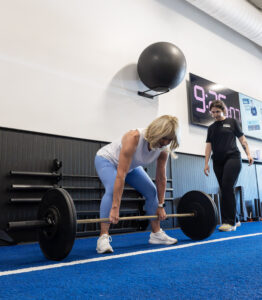
Why Adults Over 40 Need This Movement More Than They Think
Here’s what happens to most people in their 40s, 50s, and 60s who stop doing any loaded hip hinge work.
The glutes weaken. The hamstrings lose their ability to generate tension under load. The lower back muscles that stabilize the spine during bending and lifting become underused and deconditioned. The nervous system loses its ability to brace and coordinate those muscles efficiently.
Then they pick something up wrong. Or they step off a curb awkwardly. Or they spend a weekend doing yard work. And suddenly their back “goes out” — from something that should have been completely manageable.
That’s not a fluke. That’s the predictable outcome of a body that hasn’t been trained to handle load.
The deadlift builds the exact capacity that prevents that outcome. Strong glutes, loaded hamstrings, a braced core, a spine that knows how to stay neutral under tension. These are the physical qualities that keep adults over 40 independent, capable, and out of pain — not just in the gym, but in their actual lives.
The National Institute on Aging identifies strength training as one of the most evidence-supported interventions for maintaining functional independence in older adults. The hip hinge is central to that.
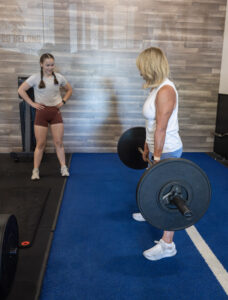
What a Safe, Well-Coached Deadlift Looks Like
There is no single “correct” deadlift. There are principles, and there are variations — and a good coach helps each person find the version that works for their body.
The principles are consistent:
- A neutral spine. The back is not rounded under load. The natural curves of the lumbar and thoracic spine are preserved throughout the lift.
- Full-body tension. The core is braced. The lats are engaged. The grip is firm. Tension creates stability.
- Hip hinge, not squat. The movement is driven by loading the hips back, not dropping the knees forward. The hips do the work.
- Load matched to capacity. Progressive overload means starting with what you can control and building from there. Not ego. Not speed. Control.
The variations are many:
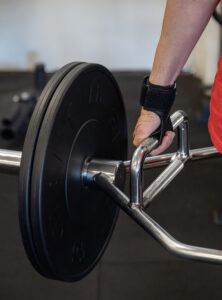
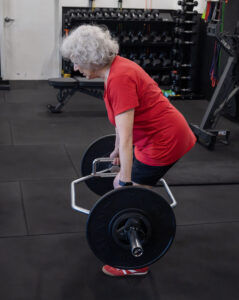
- Trap bar deadlifts are often ideal for beginners or those with mobility limitations — the load is centered under the body rather than in front of it, which reduces shear on the spine.
- Romanian deadlifts train the hinge pattern with more emphasis on the hamstrings and a shorter range of motion.
- Single-leg variations build unilateral strength and balance alongside the primary hinge pattern.
The variation matters less than the principle. A well-coached trap bar deadlift at moderate load does more for a 58-year-old’s back health than avoiding the movement entirely ever will.
What to Do If You’ve Been Told to Avoid Deadlifts
Start by asking a better question.
“Should I deadlift?” is not the right question. “What version of a hip hinge is appropriate for my current capacity and history?” is.
If you’ve had a disc injury, a compression fracture, or an acute spinal issue, you need individualized assessment before loading any pattern — that’s reasonable and appropriate. Some people need a period of rehab before they’re ready to load the hinge under resistance.
But for the vast majority of adults who’ve been told to “avoid heavy lifting” as a general precaution, that guidance deserves scrutiny. The research does not support blanket avoidance of loaded hip hinge patterns as a long-term strategy for back health. In most cases, the opposite is true.
A qualified coach who understands pain-informed training can help you find the entry point that’s right for you — and build from there.
Move Better. Feel Better. Live Stronger.
Quick Take: FAQ
Q: Is deadlifting safe if I have lower back pain?
A: It depends on the cause and severity. For most people with chronic low back pain, a properly coached hip hinge with appropriate load actually helps — because it builds the posterior chain strength the spine needs for support. Acute injuries require assessment first.
Q: What weight should I start with?
A: Whatever you can control with perfect form. That might be a 25-pound trap bar. That’s a completely legitimate starting point, and the research on progressive overload is clear: starting light and building systematically produces better long-term outcomes than starting heavy.
Q: Do I need to deadlift with a barbell?
A: No. The trap bar, dumbbells, kettlebells, and resistance bands can all be used to train the hip hinge pattern effectively. The implement matters less than the movement quality.
References
- Aasa U, et al. “Injuries among weightlifters and powerlifters: a systematic review.” British Journal of Sports Medicine. 2017.
- McGill SM. Low Back Disorders: Evidence-Based Prevention and Rehabilitation. 3rd Edition. Human Kinetics.
- Berglund L, et al. “Which patients with low back pain benefit from deadlift training?” Journal of Strength and Conditioning Research. 2015.
- National Institute on Aging. “Exercise and Physical Activity for Older Adults.” nia.nih.gov