
What the Research Actually Says — And What We See Every Day at Block Fitness
Have you ever noticed how birthdays start to feel different after 30?
Not because of the candles—but because of the quiet questions that creep in.
“Am I too old to get strong again?”
“Is muscle loss just part of aging?”
“Did I miss my window?”
We hear these questions daily inside our gyms at Block Fitness here in Oro Valley, Tucson, and the Catalina Foothills.
And the short answer is reassuring:
Yes—you can build muscle well beyond your 30s.
Into your 40s, 50s, 60s, and even your 70s.
What changes with age is not possibility.
It’s how intentionally you train, recover, and fuel your body.

The Short Answer…
You can build muscle after 30 with proper strength training, nutrition, and recovery.
Research consistently shows that adults in their 30s, 40s, 50s, 60s, and 70s can gain meaningful muscle mass and strength.
Peak muscle-building years tend to occur earlier in life—but muscle tissue remains trainable for decades.
At Block, we see this play out every day through semi-private personal training built for real humans, not fitness myths.
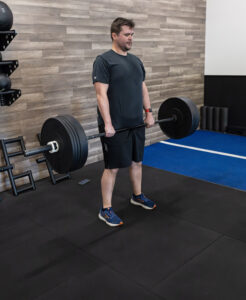
When Do Humans Naturally Accumulate the Most Muscle?
Most people reach their highest untrained muscle mass between ages 20–30.
This happens because of:
- Higher anabolic hormones (testosterone, growth hormone, IGF-1)
- Faster recovery capacity
- Greater tolerance for high training volume
- Fewer life stressors interfering with sleep and nutrition
But here’s the detail that often gets missed:
👉 Peak muscle mass does not equal peak potential.
Most adults in their 20s never train consistently enough to reach anything close to their true strength ceiling.
What Actually Happens After Age 30?
After 30, a few things begin to shift:
- Hormones decline gradually, not suddenly (≈1% per year in men)
- Recovery capacity becomes more valuable than training volume
- Muscle loss (sarcopenia) becomes a risk—but only with inactivity
Here’s the key insight we teach our members:
Aging reduces efficiency, not adaptability.
Your body still responds to resistance training.
It just responds best when training is smart.
Sarcopenia Is Not Inevitable (And This Matters More Than Weight Loss)
Sarcopenia—the age-related loss of muscle mass—is one of the biggest drivers of:
- Falls and fractures
- Loss of independence
- Slower metabolism
- Difficulty losing weight
- Chronic joint pain
What we’ve found works best for adults 40+ isn’t endless cardio or extreme dieting.
It’s strength training done consistently and safely.
Resistance training has been shown to:
- Preserve and rebuild muscle mass
- Improve balance and coordination
- Increase bone density
- Reduce fall risk
- Improve insulin sensitivity and fat loss
This is why our personal training programs prioritize strength first, especially for adults over 50, 60, and 70.
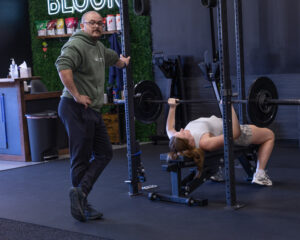
What the Research Says About Muscle Growth After 30
Decades of research agree on several points:
- Skeletal muscle remains responsive to progressive overload across the lifespan
- Older adults experience significant hypertrophy with resistance training
- Relative strength gains in older beginners can rival younger adults
- Strength training improves:
- Muscle protein synthesis
- Neuromuscular efficiency
- Functional independence
Many people who start training later in life gain more muscle than they ever had when they were younger—because they’re finally training consistently.
What Changes With Age (And What Matters Most)
| Factor | Younger Adults | Adults 30+ |
|---|---|---|
| Muscle gain rate | Faster | Slower but meaningful |
| Recovery needs | Lower | Higher |
| Volume tolerance | Higher | Moderate |
| Protein needs | Moderate | Higher per kg |
| Injury margin | Wider | Narrower |
| Technique importance | High | Non-negotiable |
This is why cookie-cutter workouts fail adults over 40.
At Block Fitness, we coach movement quality, joint integrity, and long-term progression—not burnout.
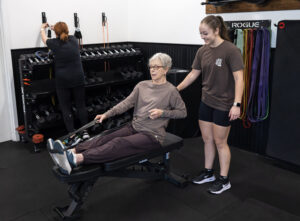
How to Build Muscle After 30 (Evidence-Based and Real-World)
1. Training That Works Long-Term
- Strength training 2–4x per week
- Moderate to heavy loads (≈60–85% 1RM)
- Emphasis on technique and joint-friendly ranges
- Smart volume management
- Planned recovery and deloads
This is exactly why we use semi-private training—individual coaching without the isolation of one-on-one or the chaos of group classes.
2. Nutrition That Supports Muscle (and Fat Loss)
- Protein intake: ~1.6–2.2 g/kg bodyweight
- Adequate calories (chronic dieting stalls muscle growth)
- Prioritize nutrient-dense, whole foods
- Consistent meals beat perfection
Many adults struggling to lose weight actually need more muscle, not fewer calories.
3. Recovery Is No Longer Optional
- High-quality sleep
- Stress management
- Proper spacing between sessions
- Listening to joints—not ego
Recovery is where muscle is built. Training is just the signal.
Strength Training Over 40, 50, 60, and 70+
We train:
- Adults returning after decades away from the gym
- Members rebuilding after injury
- Clients focused on preventing falls
- People who want to age with confidence
And the pattern is consistent:
Strength restores capability. Capability restores confidence.
That’s what changes lives—not just aesthetics.
✅ Quick Take
Can you build muscle after 30?
Yes. Muscle can be built into your 70s with resistance training.
❓ Is muscle loss inevitable with age?
No. Sarcopenia is largely driven by inactivity.
❓ Is strength training safe for older adults?
Yes—when coached properly and progressed intelligently.
❓ Does strength training help with weight loss after 40?
Yes. More muscle improves metabolism and insulin sensitivity.
The Bottom Line
You can build muscle after 30, 40, 50, and beyond.
The difference isn’t whether it can be done.
It’s how deliberately you train, recover, and fuel your body.
In our experience at Block Fitness, many adults become stronger in their 50s and 60s than they ever were in their 20s—because they finally train with purpose.
Move Better. Feel Better. Live Stronger.
If you’re curious what smart strength training could look like for your body, booking an assessment is often the simplest first step.
References (Research-Backed)
- Phillips, S. M., & Winett, R. A. (2010). Uncomplicated resistance training and health-related outcomes.
- Peterson, M. D., et al. (2011). Resistance exercise for muscular strength in older adults.
- Morton, R. W., et al. (2018). Protein intake and resistance training effects on muscle mass.
- Fragala, M. S., et al. (2019). Resistance training for older adults: Position stand.
- Lexell, J. (1995). Human aging, muscle mass, and fiber type composition.