
By Ethan & The BLOCK FITNESS® Coaching Team | BLOCK FITNESS® — Oro Valley & Catalina Foothills, Tucson, AZ
Published March 2026 | 8 min read
Every few years, the science catches up to what great coaches already know. And this time, it’s worth paying attention.
The American College of Sports Medicine (ACSM) just released its first major update to resistance training guidelines in 17 years. It’s called the 2026 ACSM Position Stand on Resistance Training, and it synthesized 137 systematic reviews covering more than 30,000 participants — the most comprehensive summary of strength training science ever published in a single document.
At BLOCK FITNESS in Tucson — with locations in Oro Valley and the Catalina Foothills — we’ve been coaching these principles since day one. But for a lot of people over 40 who are trying to get stronger, move better, and stay out of the physical therapist’s office, this update is a meaningful shift in how the fitness world talks about training.
Here’s what changed, what it means, and why it matters — especially if you’re training in a semi-private or personal training setting in Tucson.
What the Old Guidelines Said (And Why They Were Frustrating)
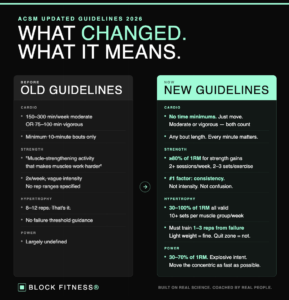
For most of the past two decades, the ACSM’s guidance on resistance training was vague at best. The old language called for “muscle-strengthening activity that makes your muscles work harder than usual” at least twice per week. For cardio, you needed 150–300 minutes per week of moderate activity, with bouts of at least 10 minutes.
Hypertrophy — the science-backed process of building muscle — was prescribed in an 8–12 rep range with little flexibility. And power training? Largely undefined.
For people over 40 who wanted evidence-based guidance on how to train for strength, muscle preservation, and injury prevention, the old guidelines left a lot of gaps. In a semi-private training environment like BLOCK FITNESS, where coaches are adjusting programs in real time for clients ranging from their 20s to their 80s, vague prescriptions don’t cut it.
What the ACSM 2026 Update Actually Changed
The update covers four major areas: cardio, strength, hypertrophy, and power. Here’s the breakdown.
Cardio: No More Time Minimums
The ACSM dropped the requirement for minimum 10-minute bouts of cardio. The new guidance is simple: just move. Moderate or vigorous, as often as you can manage. Every minute of movement counts toward the massive downstream benefits — immune function, soft tissue health, blood pressure regulation, glucose control, and insulin sensitivity.
For people over 40 in Tucson who are juggling work, family, and trying to stay active in the heat, this is actually great news. A 7-minute walk counts. A set of stairs counts. The bar to benefit just got a lot more accessible.
Strength Training: Consistency Beats Complexity
The new specifics for building strength:
- ≥80% of your one-rep max (1RM)
- 2 or more sessions per week
- 2–3 sets minimum per exercise
But here’s the headline finding that runs through the entire document: the #1 driver of results isn’t intensity. It isn’t program complexity. It isn’t muscle “confusion.” It’s showing up consistently.
The ACSM’s Position Stand is explicit: the most meaningful gains come from moving from no resistance training to any form of resistance training. A consistent routine built around the major muscle groups, done twice per week, produces significant improvements in strength, muscle preservation, and functional capacity — regardless of whether it’s done with barbells, machines, bands, or bodyweight.
For our clients over 40 at BLOCK FITNESS, this is one of the most validating things science has said in years. You don’t need the perfect program. You need to keep coming back.
Hypertrophy: The 8–12 Rep Rule Is Gone
This is the update that’s getting the most attention in the coaching world — and for good reason. The old 8–12 rep hypertrophy rule has been replaced with a much wider window: 30–100% of your 1RM, all valid for building muscle.
The new hypertrophy targets:
- 10 or more sets per muscle group per week
- Load range of 30–100% of 1RM — any of it works
- Train within 1–3 reps of failure (Reps in Reserve, or RIR)
The critical caveat: proximity to failure matters more than the weight on the bar. Research now confirms that training to within 0–3 reps of failure produces similar strength and hypertrophy gains across a wide range of loads. What drives adaptation isn’t the absolute load — it’s the neuromuscular effort and metabolic demand of getting close to your limit.
What this means for people over 40: lighter weights are not a consolation prize. They’re a completely valid training stimulus for muscle growth — as long as you’re pushing near your limit. This is a game-changer for joint-friendly programming, post-injury training, and anyone rebuilding capacity after time off.
It’s also a major reason why the semi-private training model at BLOCK FITNESS works so well for this demographic. When a coach is with you on the floor, they can see when you’re working hard enough — and when you’re leaving too much in the tank.
Power Training: Finally Defined
Power — the ability to move a load quickly — now has a clear prescription: 30–70% of 1RM, moved as explosively as possible during the concentric (lifting) phase. This is hugely relevant for people over 40, because power declines faster than strength with age. Maintaining power is directly linked to fall prevention, functional independence, and quality of life.
When your BLOCK FITNESS coach tells you to slam the slam ball or explode out of the bottom of a goblet squat — that’s not just energy. That’s evidence-based power training.
Progressive Overload: The Engine Behind Every BLOCK FITNESS Program
One of the principles the ACSM 2026 update reinforces most strongly is progressive overload — gradually increasing the challenge placed on the body over time.
Here’s the nuance that matters: we don’t make things harder so that you get stronger. We use progressive overload because you’re already getting stronger. Your body adapts to a stimulus, and then it needs more. That’s not punishment — that’s progress.
At BLOCK FITNESS, progressive overload looks like:
- Adding weight to the bar or machine
- Adding reps within the same load
- Adding sets over time
- Increasing training frequency
- Improving tempo, control, or technique
- Advancing to a harder exercise variation
The key rule: it has to be harder than before. That’s why adherence — actually following the workout as prescribed, with the right tempo, the right load, the right technique — matters as much as showing up. Our coaches aren’t being particular for the sake of it. They’re managing your long-term progress.
Why People Over 40 in Tucson Need to Pay Attention
The ACSM’s 2026 Position Stand isn’t just relevant for young athletes or gym enthusiasts. It’s arguably most important for adults over 40 — the population facing the steepest decline in muscle mass, bone density, and power output if they don’t train consistently.
Here’s what the research tells us about aging and resistance training:
- Muscle mass naturally declines by 3–8% per decade after 30, and faster after 60. Consistent resistance training is the most effective intervention to slow and reverse this.
- Power declines even faster than strength. The ACSM now explicitly addresses power training as a separate category — and for people over 40, maintaining explosive capacity is directly linked to fall prevention and functional independence.
- Joint-friendly training is fully validated. Because loads from 30–100% of 1RM now produce similar hypertrophy results when taken close to failure, people over 40 with knee, shoulder, or hip concerns can train hard — and smart — without needing to go heavy.
- Injury prevention is built into the model. The new guidelines confirm that training 1–3 reps short of failure — not to complete failure — reduces injury risk while preserving the training stimulus. Our coaches manage this in every session.
This is exactly why BLOCK FITNESS’s semi-private training model exists. Coaches are on the floor with you, watching technique, adjusting loads, and managing your training at the edge of your actual capacity — not some generic version of it.
Semi-Private Training in Tucson: Why the Model Matches the Science
The ACSM Position Stand makes one thing clear above all else: individualization beats prescription. The best program is the one you’ll actually stick with, that challenges you relative to your own capacity, and that gets adjusted based on how you’re actually responding.
That’s not what happens in a large group fitness class where everyone does the same workout. And it’s not what happens when you’re left alone to figure out your own program in a big-box gym.
The semi-private training model at BLOCK FITNESS — small groups, dedicated coaching attention, individualized programming — is structurally built to deliver exactly what the science now recommends:
- Personalized load selection based on your 1RM or estimated effort level
- Real-time coaching on proximity to failure so you’re working hard enough — but smart enough
- Progressive overload tracked session to session
- Exercise modifications for injuries, chronic pain, or mobility limitations
- Accountability that drives the consistency the science now confirms is the #1 factor in results
Whether you’re training at our Oro Valley location or our Catalina Foothills gym, this is what every session is built to deliver. We serve clients ranging from teenagers to adults in their 80s — and the programming adapts to every one of them.
What This Means for Your Training Right Now
If you’re already training at BLOCK FITNESS, you’re doing most of this. Now you know why.
If you’re not training consistently yet — or if you’ve been told you’re “too old,” “too injured,” or that your body “can’t handle” strength training — the 2026 ACSM guidelines directly challenge that narrative. The research is clear: the most important variable is simply starting and staying consistent.
Here’s how to think about it:
- Cardio: Stop waiting until you have 30 free minutes. Move when you can, as hard as you can.
- Strength: Two sessions a week, major muscle groups, 2–3 sets per exercise. Show up.
- Hypertrophy: The weight doesn’t have to be heavy. It has to be challenging enough that you’re working near your limit. Light and hard beats heavy and easy.
- Power: Move fast with intent. Slam the slam ball. Explode off the floor. Your future self will thank you.
Don’t know your 1RM? Not sure where your effort level actually is? That’s exactly what the coaches at BLOCK FITNESS are here for. We’ll get you dialed in.
Train at BLOCK FITNESS in Tucson — Oro Valley and Catalina Foothills
BLOCK FITNESS is Tucson’s semi-private strength training gym built for real people at every stage of life. Our two locations — in Oro Valley and the Catalina Foothills — offer semi-private training, personal training, and small group fitness coached by professionals who follow the science and know how to apply it.
If you’re over 40 and looking to get stronger, reduce injury risk, or simply build a training foundation that actually lasts — we’d love to have you in.
The science just caught up. We’ve been here.
Ethan & The BLOCK FITNESS® Team
BLOCK FITNESS® — Oro Valley & Catalina Foothills, Tucson, AZ