
(Yes… This Is Why Our Members Asked for “Butts by Block” Shirts)
It started as a joke.
Then a few members asked if we could make shirts.
Then stickers.
Then more people wanted them.
“Butts by Block.”
Not because we chase aesthetics.
Not because we run glute-only workouts.
But because when you train correctly—consistently, progressively, and with intent—glutes change.
And when glutes change, everything tends to feel better.
Less back pain.
Stronger knees.
More power walking uphill.
More confidence moving through life.
At Block Fitness, glute training isn’t a trend.
It’s a pillar.
Why glute training matters (far beyond looks)
Your glutes are:
- the largest muscle group in the body
- a primary driver of hip extension
- a key protector of the knees and low back
When glutes are undertrained, other tissues pick up the slack:
- low back tightness
- cranky knees
- hip discomfort
- poor balance
When glutes are strong and coordinated, movement feels easier—and safer.
That’s why we prioritize them in nearly every program we coach in Tucson, Oro Valley, and Catalina Foothills.
Before the exercises: why most glute programs fail
Most people do glute exercises.
They just don’t:
- load them progressively
- use enough range of motion
- move slowly enough to feel them work
- repeat them consistently week to week
Glutes respond to tension, range, and repetition over time.
Not novelty.
Not burn-chasing.
Not random circuits.
With that lens, here are the five exercises we rely on most.
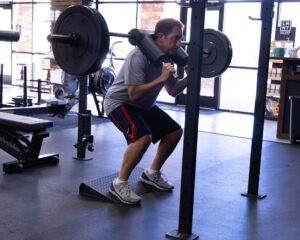
1. Squats (loaded correctly, not rushed)
Squats train the glutes when:
- depth is appropriate for the individual
- load is challenging
- tempo is controlled
We often use:
- goblet squats
- counterbalanced squats
- front-loaded squats
Why front-loaded?
Because they allow better depth, better torso position, and better glute engagement—especially for adults 35+.
Deep, controlled squats = glutes doing their job.
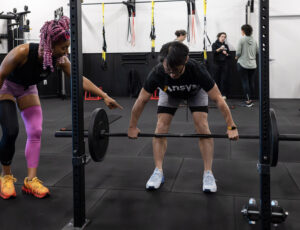
2. Hinges (deadlifts and hip hinges)
If squats are about down and up, hinges are about back and through.
Deadlifts, RDLs, and hinge variations:
- load the glutes in a lengthened position
- teach hip-driven power
- spare the spine when coached well
This is where many people finally feel their glutes working—because the hips are actually doing the work.
A strong hinge pattern is non-negotiable for glute development and back health.
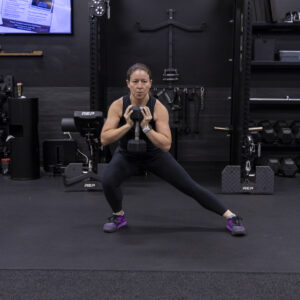
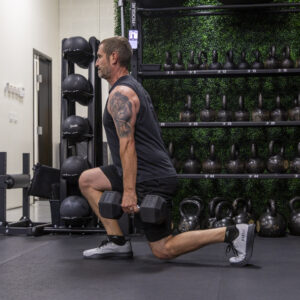
3. Split squats and lunges (the secret weapon)
If you want visible, usable glutes—this is where it happens.
Single-leg work:
- increases glute demand
- exposes side-to-side differences
- builds stability and balance
We love:
- split squats
- reverse lunges
- step-back variations
They’re humbling.
They’re effective.
And they transfer directly to real life.
This is where “Butts by Block” is earned—not gifted.
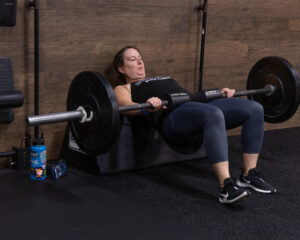
4. Hip thrusts and bridges (done heavy enough)
Hip thrusts get a lot of hype.
They earn it—when loaded properly.
These movements:
- place maximal tension on the glutes
- allow high loading with low joint stress
- complement squats and hinges perfectly
What we don’t do:
- endless light reps
- bouncing
- chasing burn without progression
What we do:
- add load slowly
- pause at the top
- treat them like a strength lift
That’s when glutes grow.
5. Carries (the sleeper glute builder)
Carries don’t look like “glute exercises.”
But they demand:
- hip stability
- pelvic control
- glute endurance
Single-side carries, in particular, force the glutes to stabilize every step.
The result?
Better posture.
Better gait.
Better real-world strength.
And yes—over time, better-looking glutes too.
Why these five work together
Each exercise hits the glutes differently:
- Squats → depth and coordination
- Hinges → lengthened tension
- Lunges → unilateral strength
- Hip thrusts → peak contraction
- Carries → stability and endurance
Together, they cover:
- strength
- size
- control
- longevity
You don’t need more variety.
You need better execution and smarter progression.
That’s where coaching matters.
How we program glutes at Block
In our semi-private training model, everyone trains glutes—but not everyone trains them the same way.
We adjust:
- stance
- range
- load
- tempo
- volume
So people with:
- knee history
- back history
- hip limitations
can still train hard without fear.
That’s why results stack up quietly over months—and why the nickname stuck.
Quick Take: Building glutes the Block way
Glutes don’t grow from:
- random workouts
- endless band burnouts
- inconsistency
Glutes grow from:
- progressive loading
- full ranges
- patience
- repetition
FAQ: Glute training for adults 35+
Is it too late to build glutes after 40 or 50?
No. Glutes respond extremely well to strength training at any age.
How often should glutes be trained?
Two to four times per week, depending on volume and recovery.
Do I need “activation” drills first?
Sometimes—but strength work is what creates lasting change.
The long-term view
Strong glutes aren’t about trends.
They’re about function.
They help you:
- move without pain
- lift without fear
- walk with confidence
- age with power
The aesthetics are just a side effect.
And yes… that’s why the shirts exist.
Butts by Block isn’t a promise.
It’s a byproduct of doing the basics exceptionally well.
Move Better. Feel Better. Live Stronger.